Walls of Resilience: Murals of Solidarity Between Native American and Palestinian Communities
Co-authored by Laura Kandle and Ahmed Hmeedat
In the West Bank, a new collaborative effort puts murals of solidarity between Palestinians and Native Americans on view.
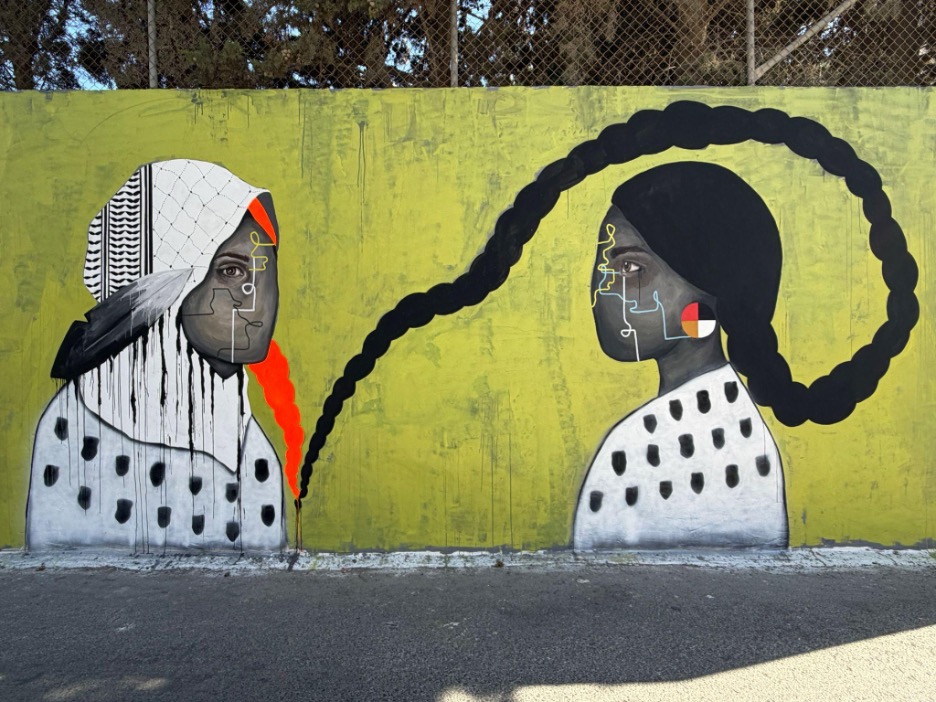
“S is for Solidarity: Mitákuye Oyás’iŋ /We Are All Related,” a mural by the artist Danielle SeeWalker, Aida Camp, 2026.
Image courtesy of Danielle SeeWalker.
BETHLEHEM, Palestine – A new series of murals at the entrance to Aida refugee camp is bringing the solidarity between Native American and Palestinian communities into public view.
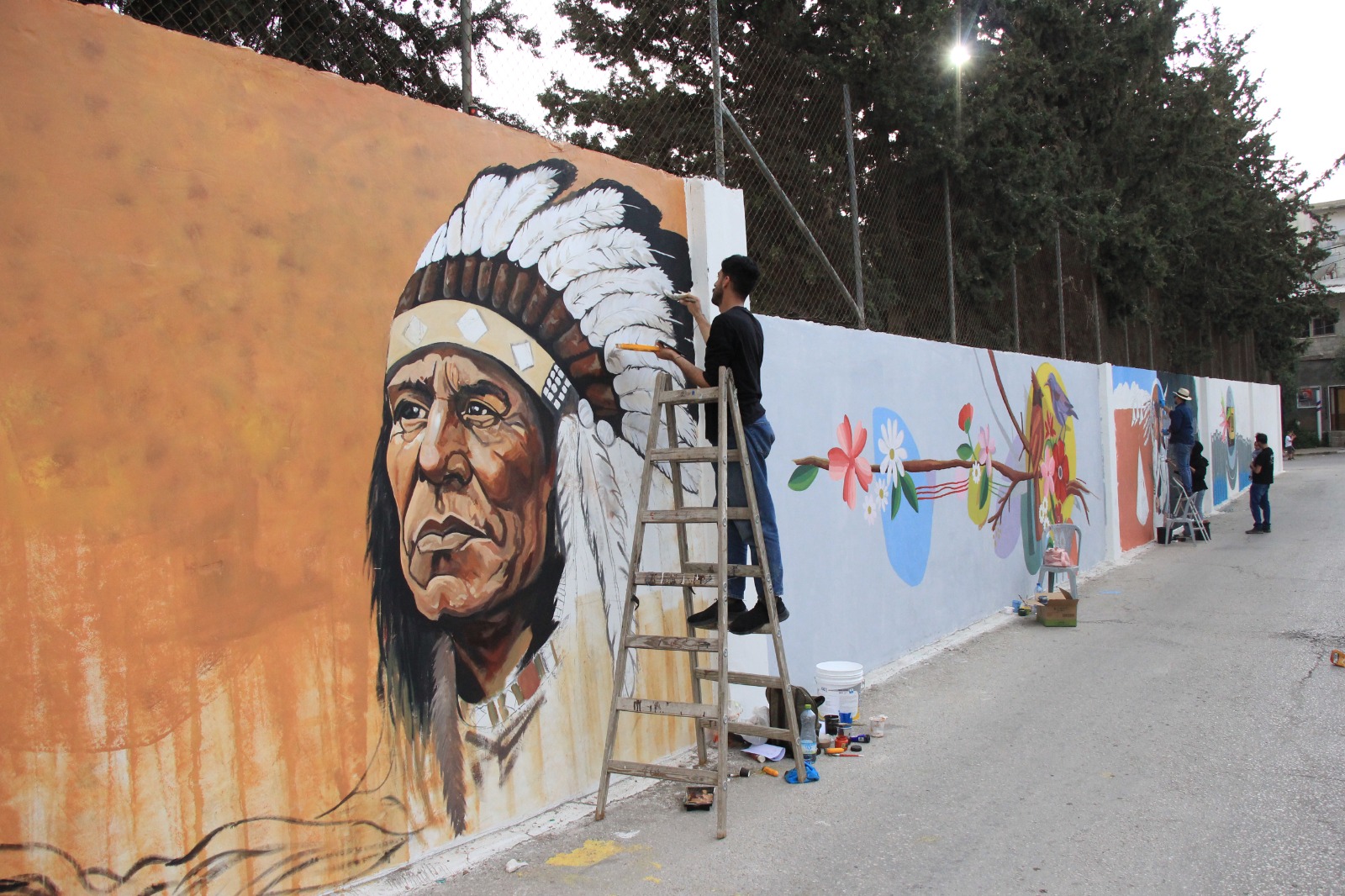
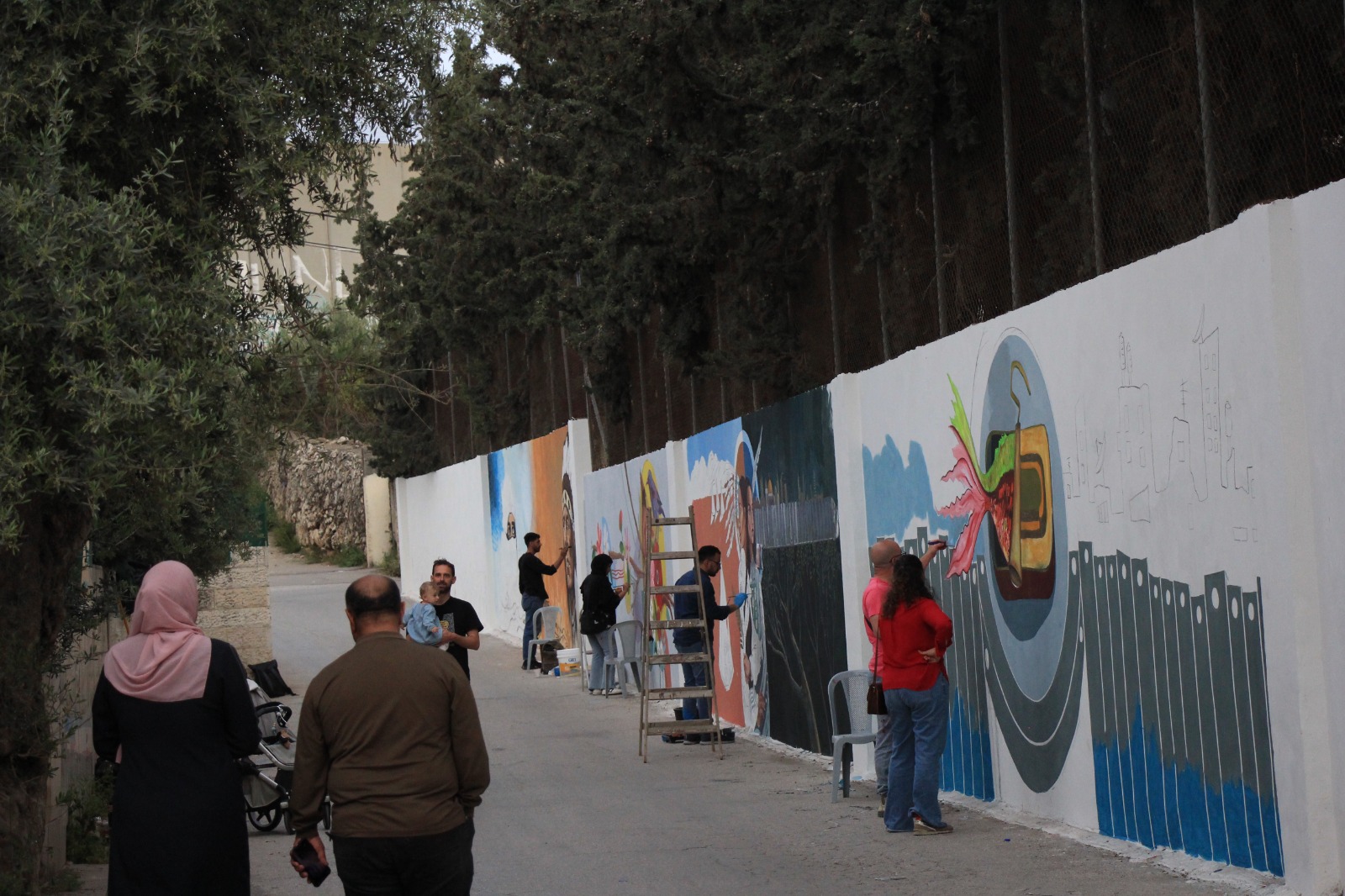
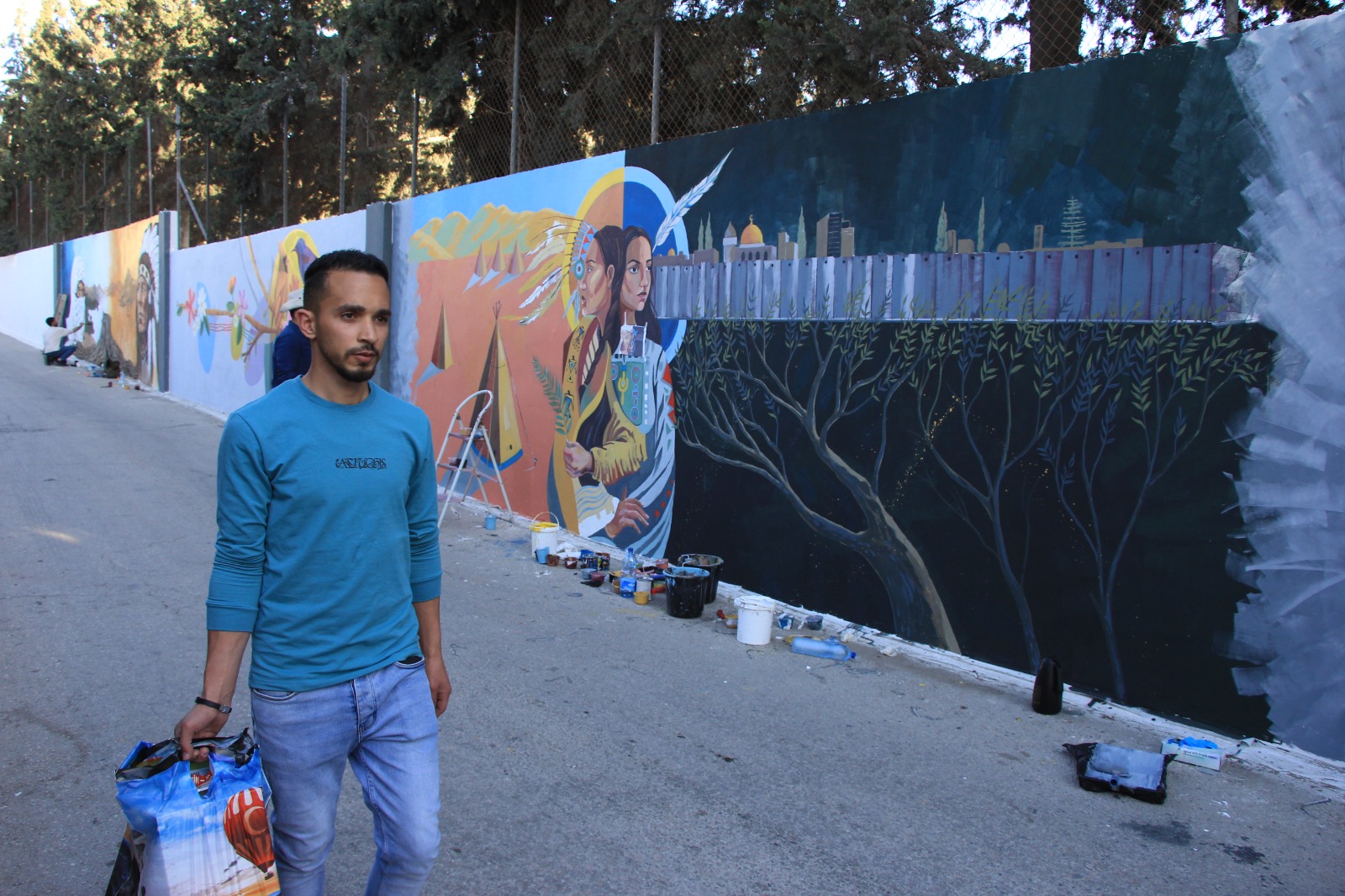
Six colorful murals depicting parallels between the Palestinian and Native American experiences now face the camp, painted along a wall at the shuttered InterContinental Hotel, which once housed tourists visiting Bethlehem.
The series is part of an ongoing collaboration between the Palestinian Artists Consortium, the Lajee Center, a grassroots organization in Aida camp, and Native American artist Danielle SeeWalker.
SeeWalker and consortium founder Ahmed Hmeedat began developing the concept in 2024.
“The journey began after I was canceled from a residency in the Town of Vail, Colorado, because of an artwork I created titled ‘G is for Genocide,’” said SeeWalker. “Through that experience, I connected with the founder of the Palestinian Artists Consortium, Ahmed Hmeedat, based in the West Bank. What began as a conversation grew into a friendship and eventually into a shared vision: to create murals along a 200-foot wall in Palestine.”
Four Palestinian artists from across the West Bank met virtually with SeeWalker to develop the concept for Walls of Resilience.
The site carries its own meaning. Reviving the walls of a closed hotel points to the collapse of tourism in the West Bank, where the decline to tourists have reached to 88.9% in Bethlehem from 2020 -2024, according to the Palestinian Central Bureau of Statistics (PCBS), The World Tourism Day, issued jointly with the Ministry of Tourism and Antiquities, on September 26, 2024. Therefore, many ho tels in Bethlehem alone have gone out of business amid the ongoing war and Israeli measures that have weakened the Palestinian economy.
On the opposite side of the wall runs a road beside a graveyard, an unsettling stretch to pass at night. A few meters away, an Israeli military tower fitted with sophisticated surveillance equipment looms over the scene. This part of the camp has seen many confrontations with the Israeli army.
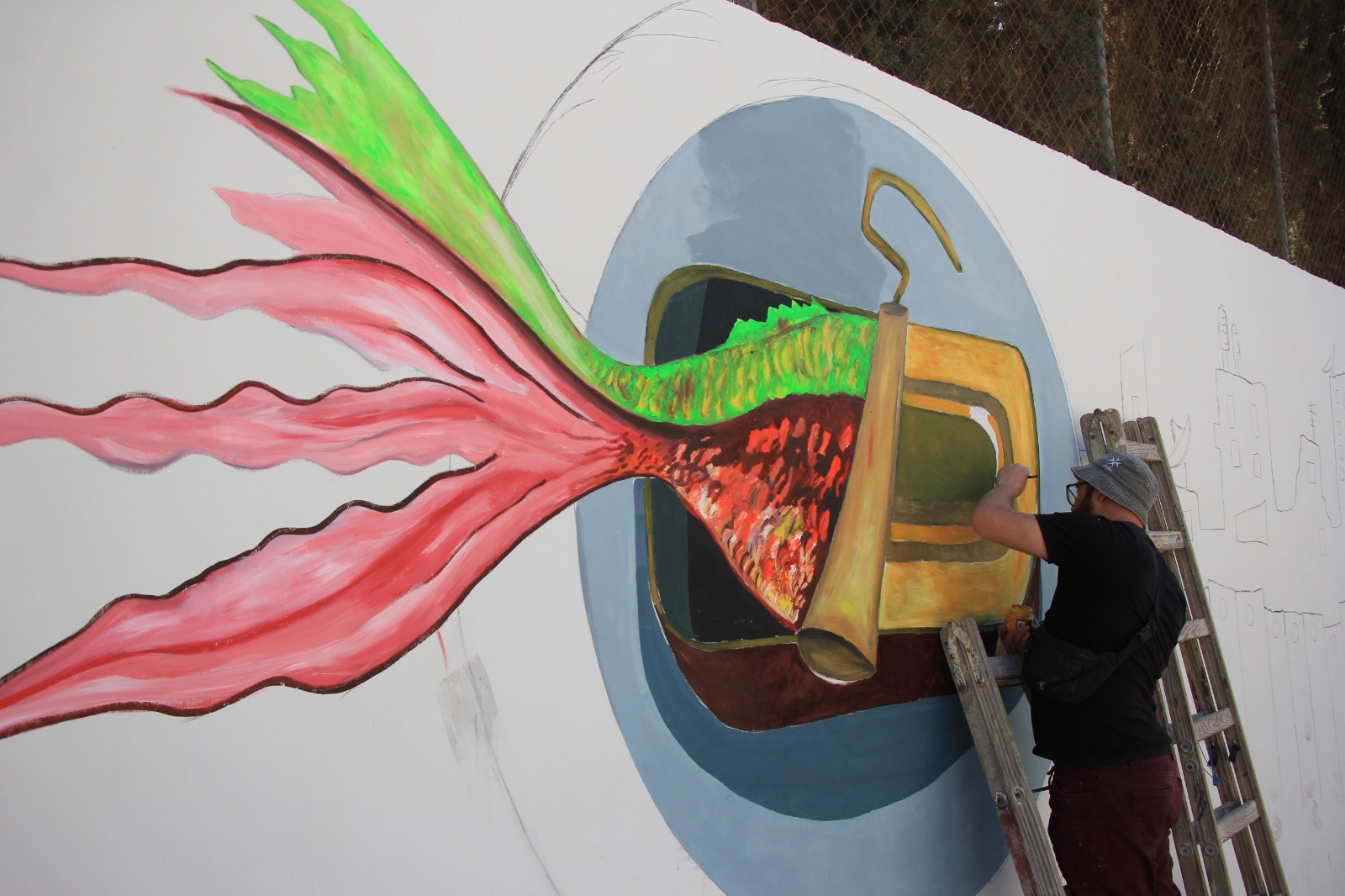
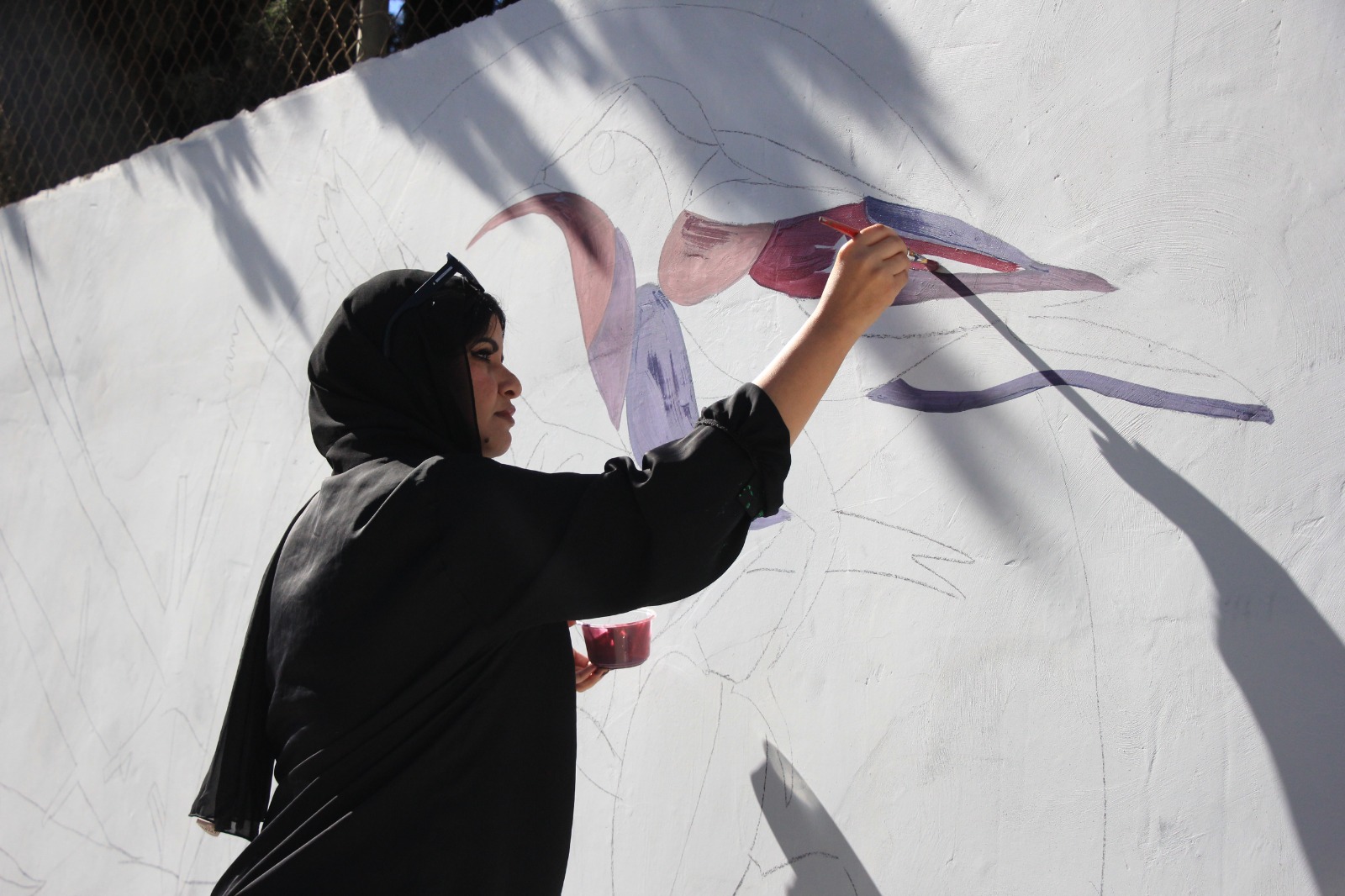
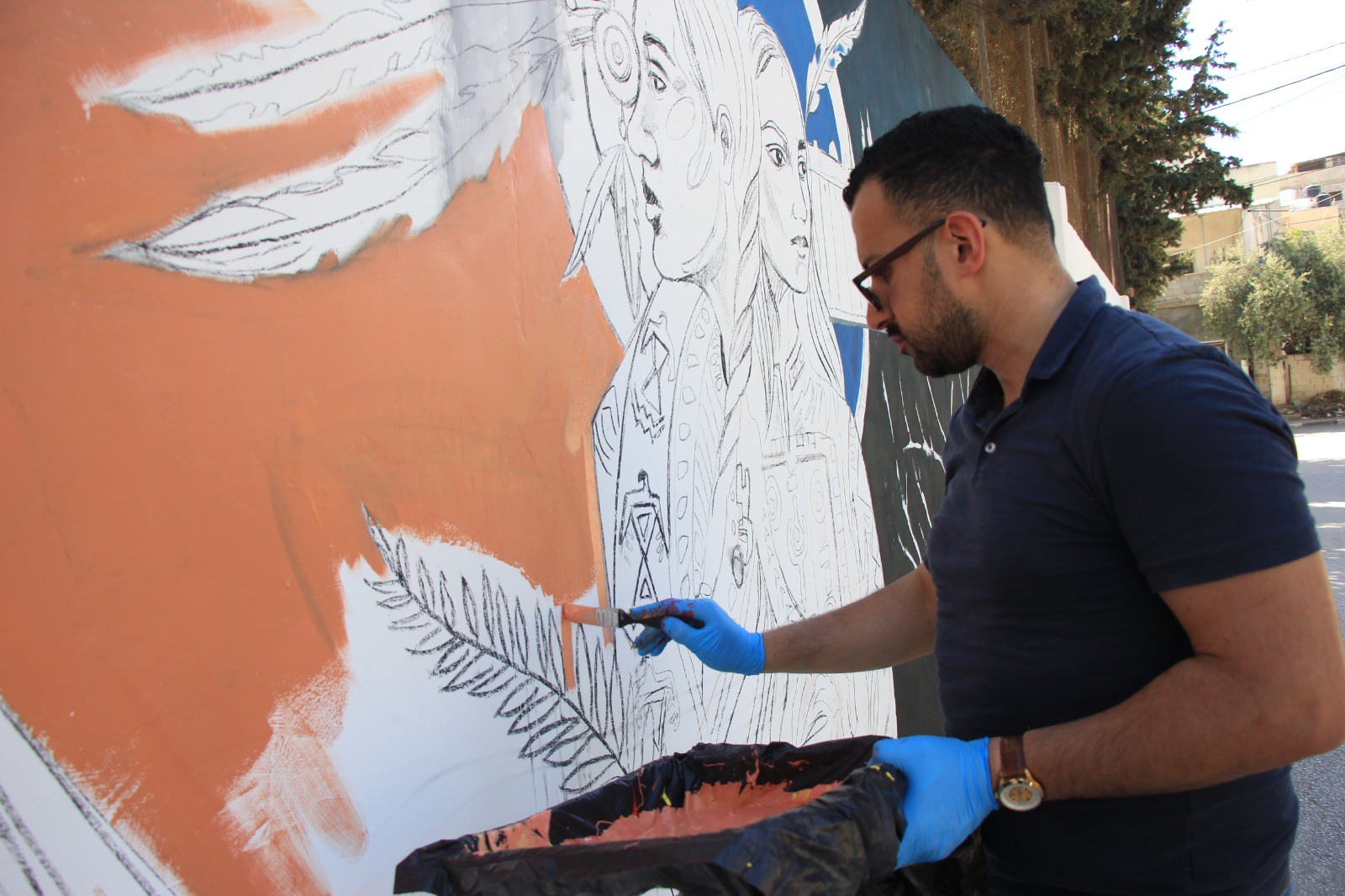
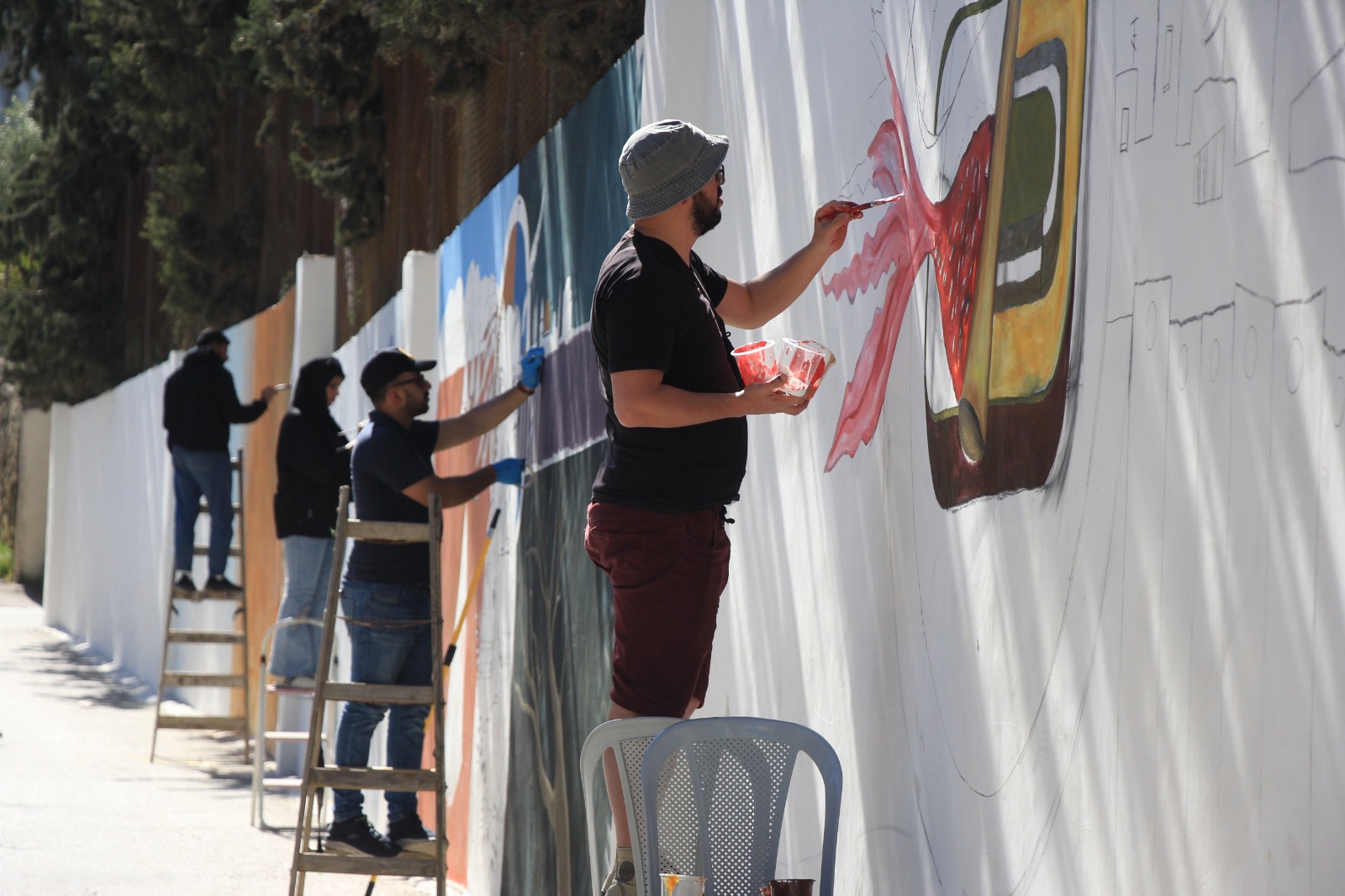
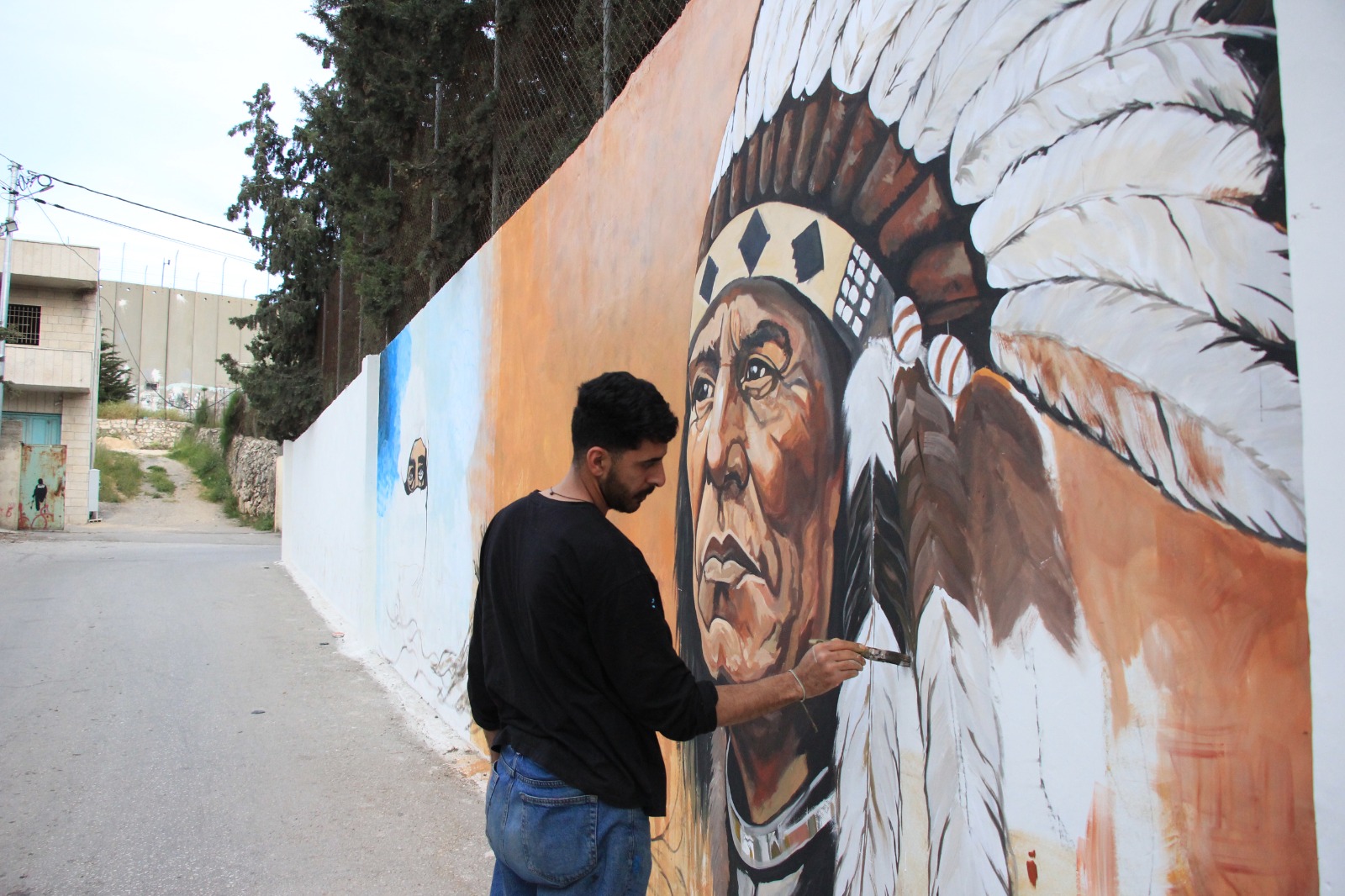
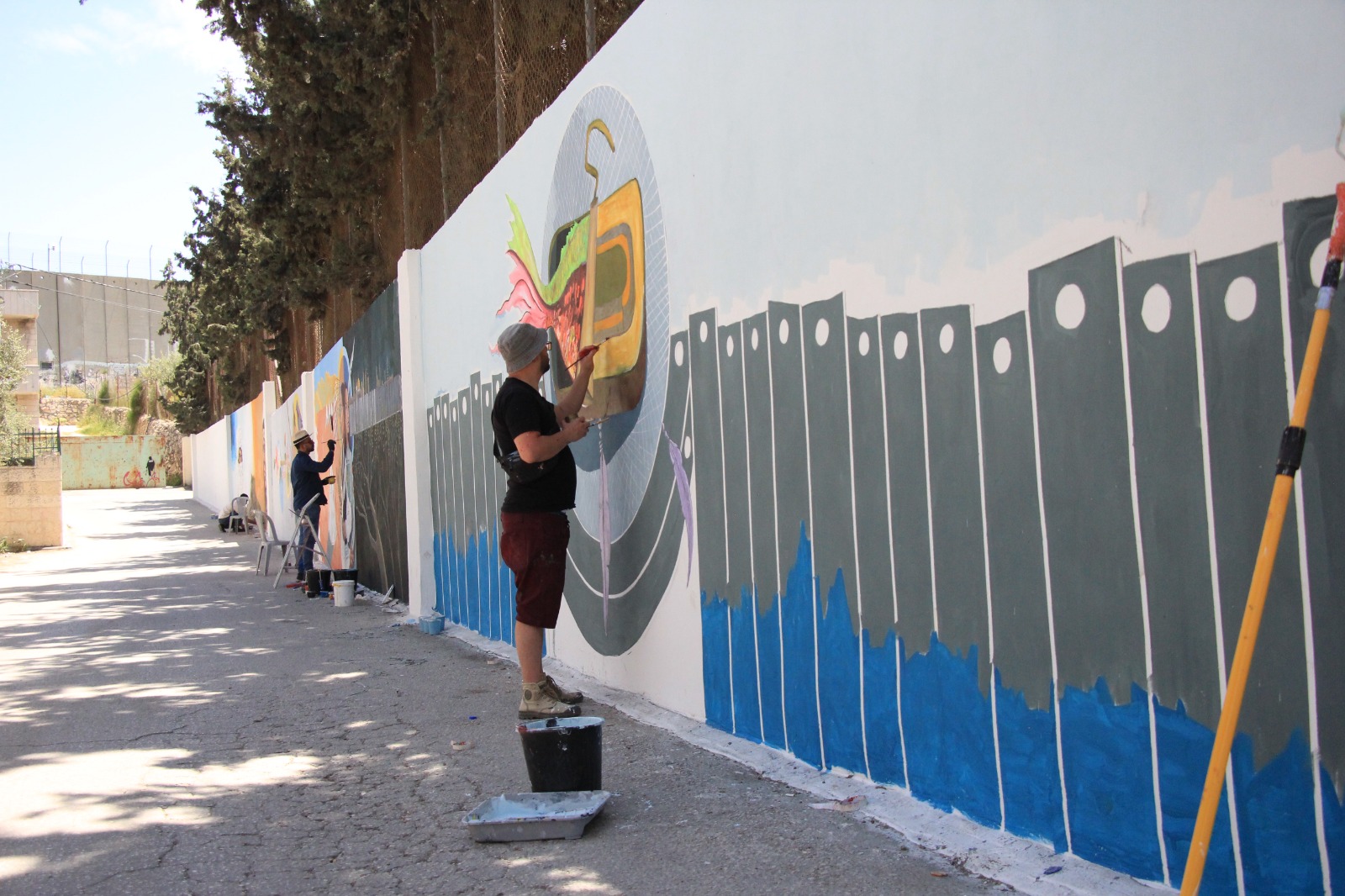
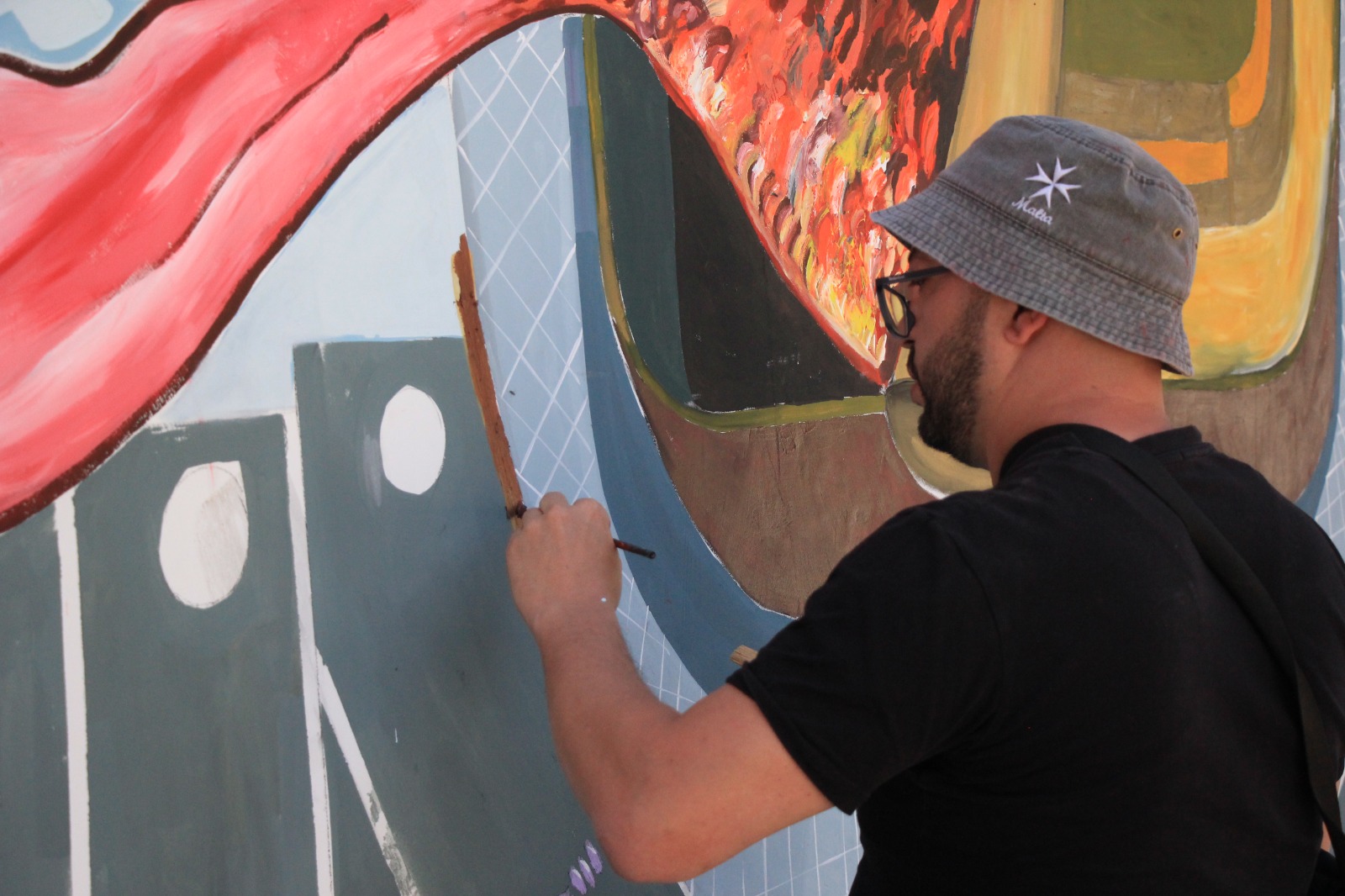
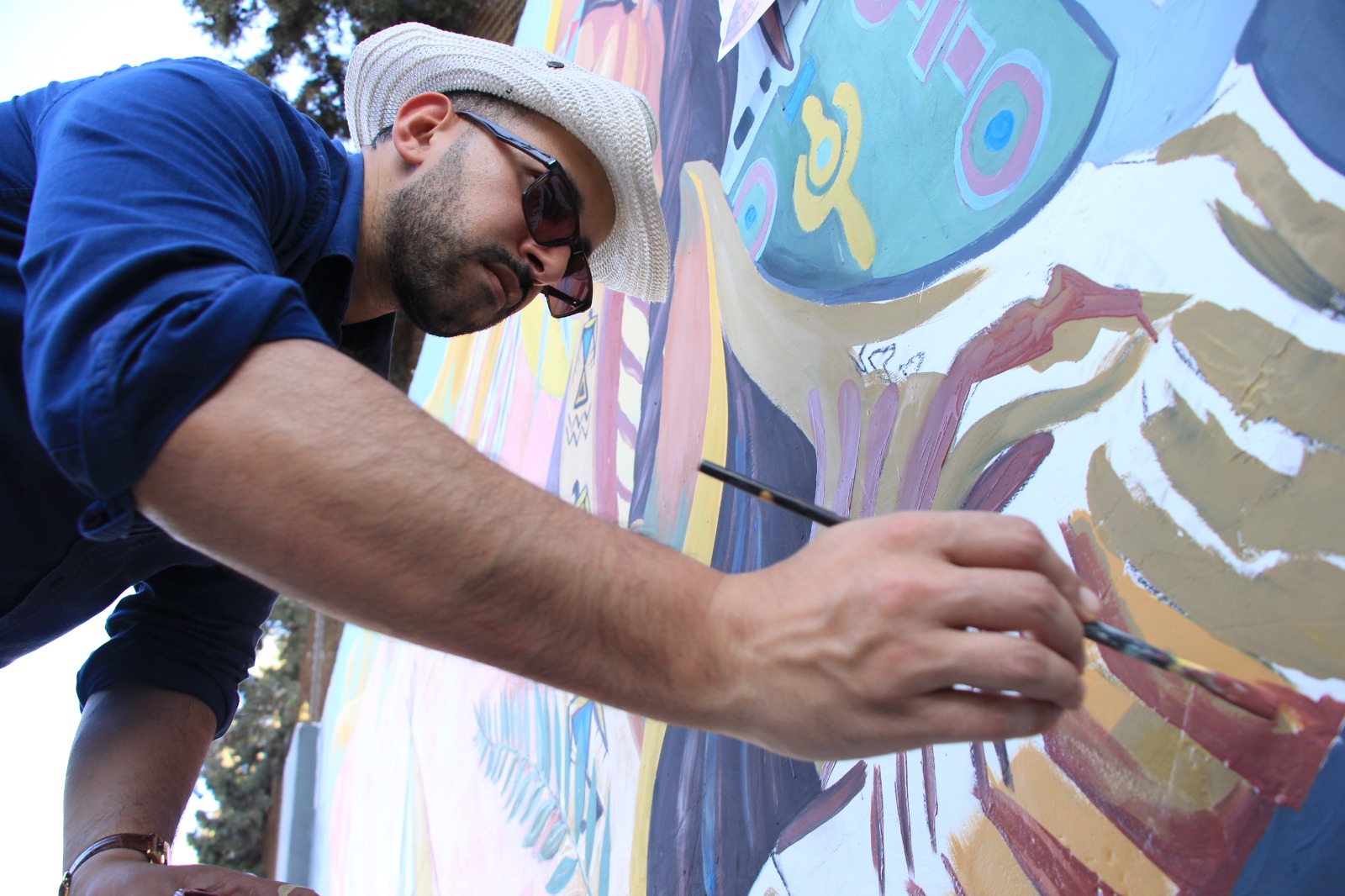
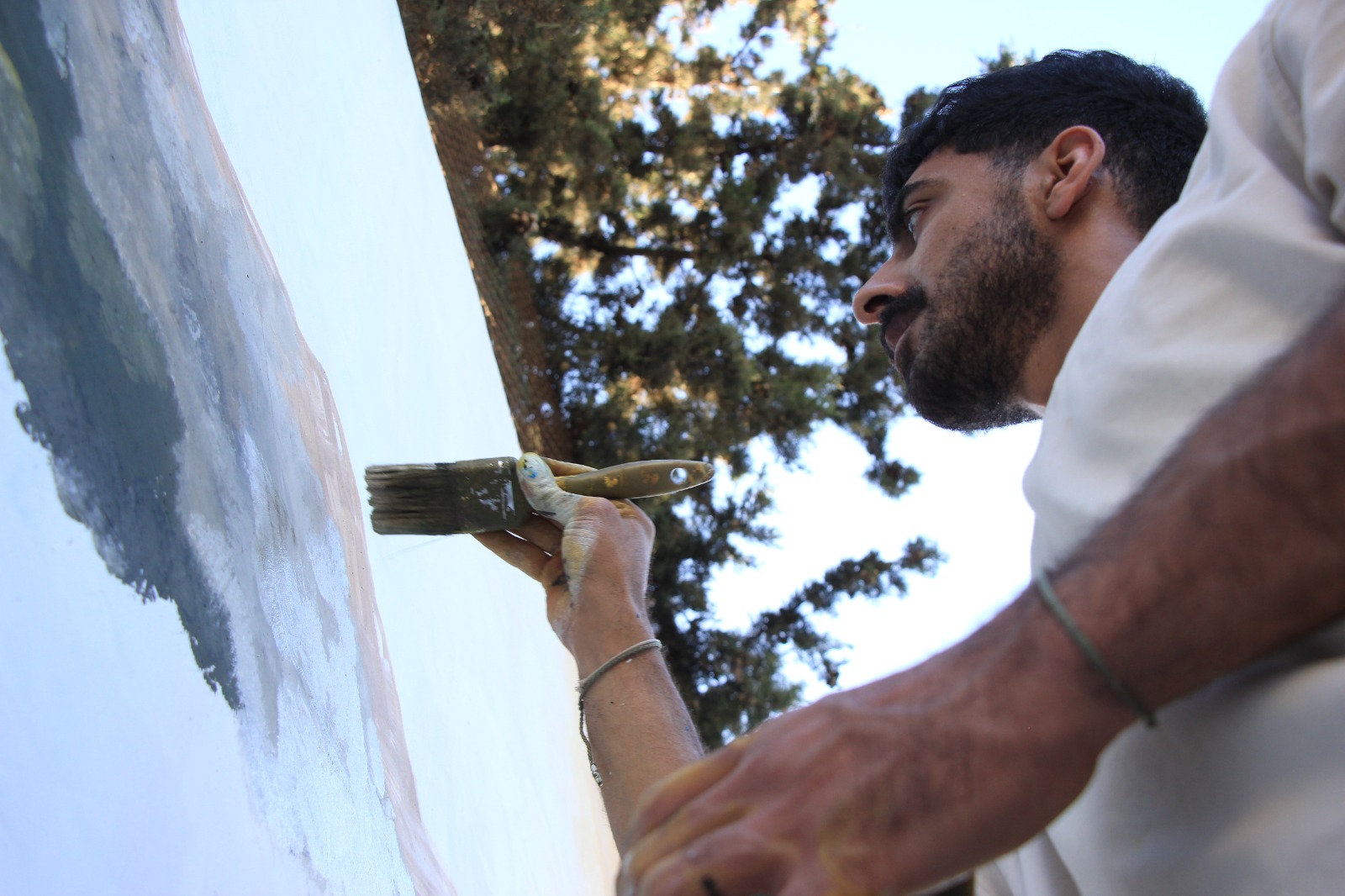
On the morning of April 22, Alaa Albaba, Ahmed Hmeedat, Haya Kaabneh, and Mohammad Al-Raee, all Palestinian visual artists from refugee camps across the West Bank, gathered and began work on the wall.
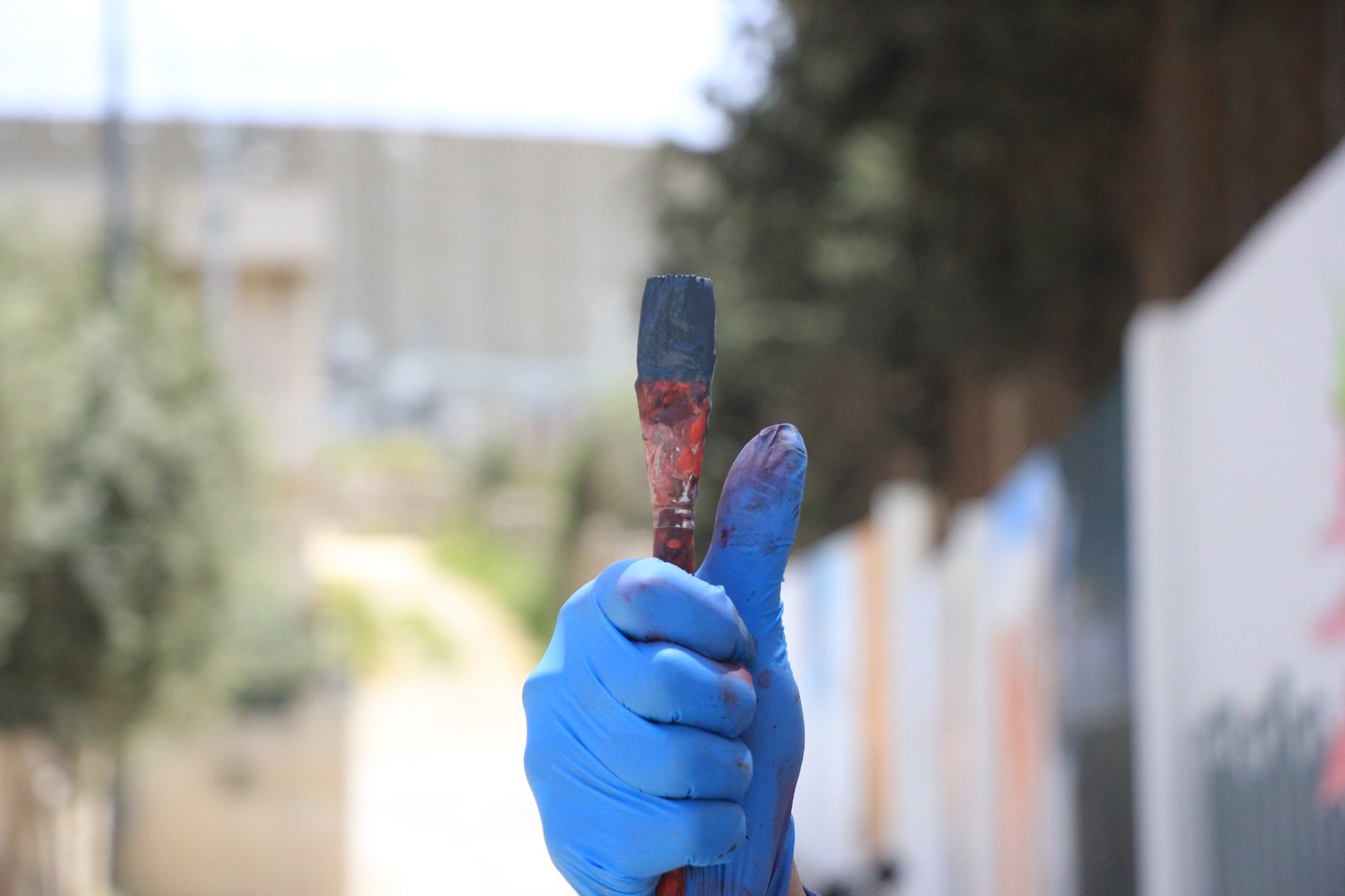
Working from dawn to dusk over nearly four days, they brought a fresh display of solidarity between communities resisting colonialism to the entrance of Aida camp.
SeeWalker, whose original arrival date was in April, but due to the ongoing war in the region, her flight was canceled, she eventually joined them on June 28.
“I am very happy with the results. It is the first time in years we have had large, well-done murals painted by local artists,” said Lajee Center director Mohammed Al-Azzah.
“This ongoing artistic endeavor is an eye-opening experience that taught me many things about street art and community art,” said Hmeedat. “I have learned new painting techniques from the participating artists and shared my experience in mural art with everyone.”
The murals now bring a sense of calm and interconnectedness to the site.
“One of the most common questions from bystanders was, ‘Why Native Americans?’” said Hmeedat. “We have a lot of similarities and common ground with Native Americans as people who live under colonization.”
“While I came to Palestine to paint, what I’ll carry home with me are the relationships,” said SeeWalker. “I sat with artists, families, and children living under the daily reality of occupation, ethnic cleansing, and genocide. I’m still processing everything I experienced and witnessed, but one truth has become undeniable: art is medicine. It reminds us that our stories matter, that our grief is witnessed, and that solidarity is not symbolic but is something we build together, one conversation, one brushstroke, one relationship at a time.”
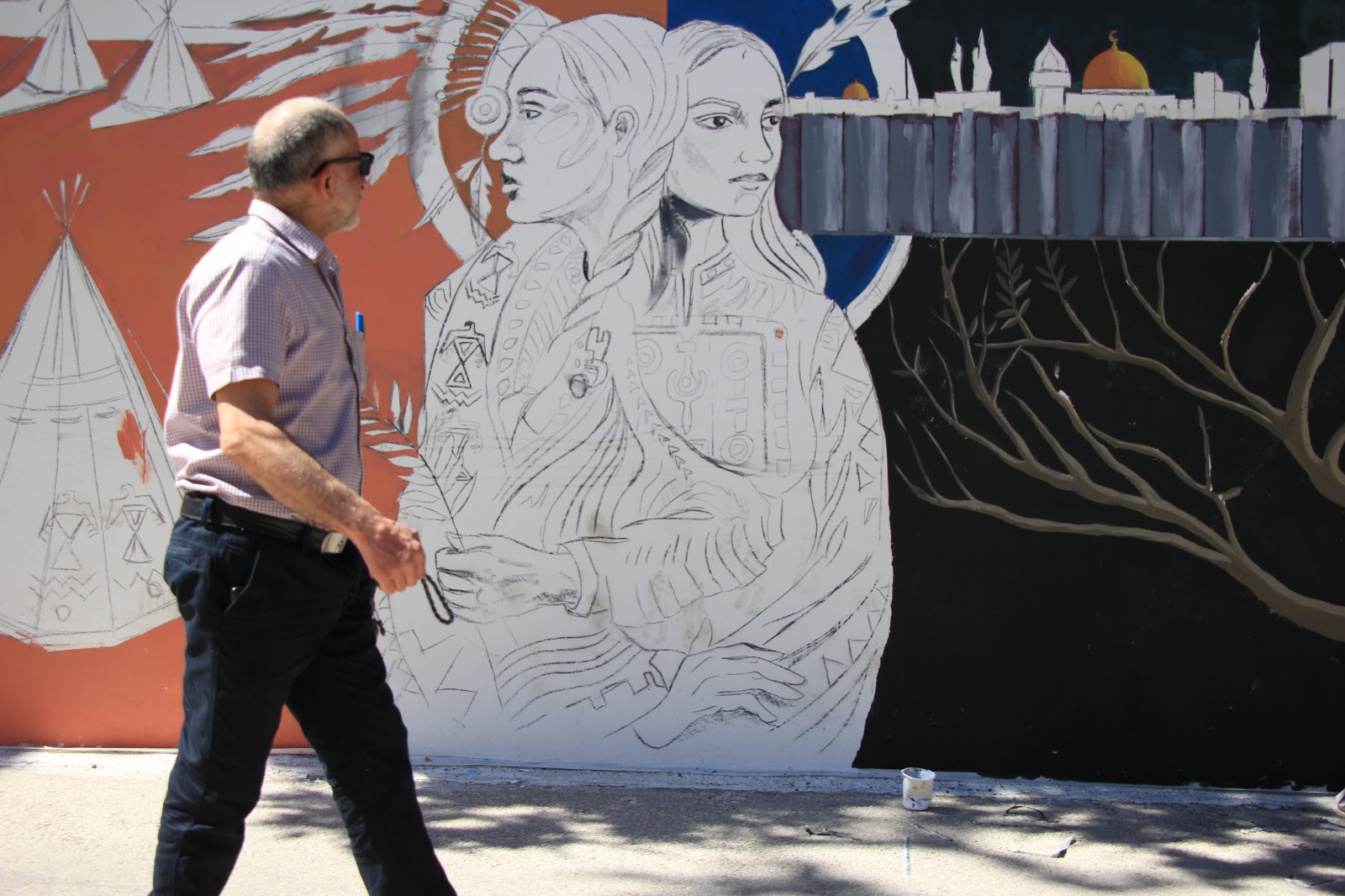
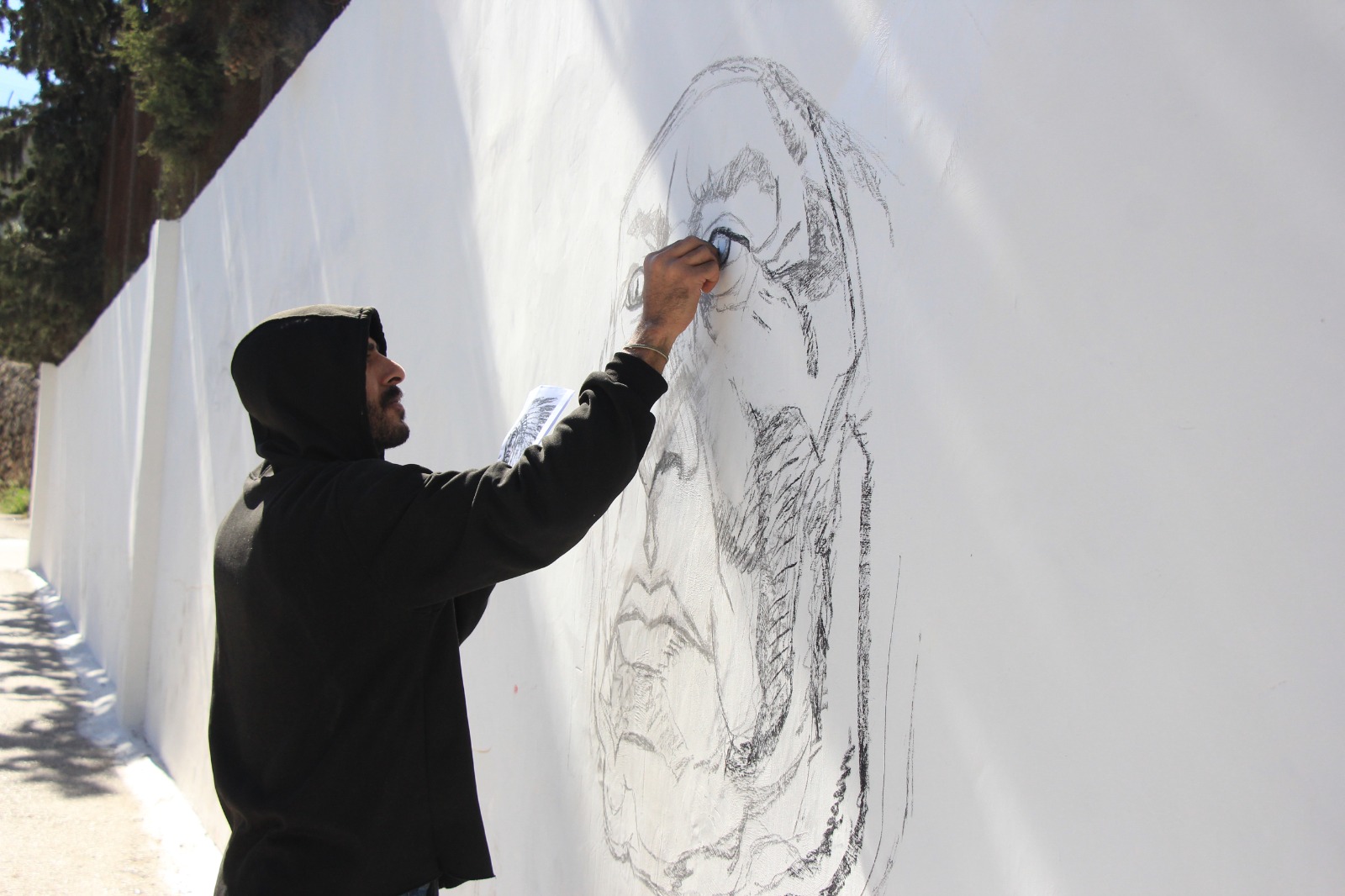
“Mitákuye Oyás’iŋ/We Are All Related,” a mural by the artist Danielle SeeWalker, Aida Camp, 2026.
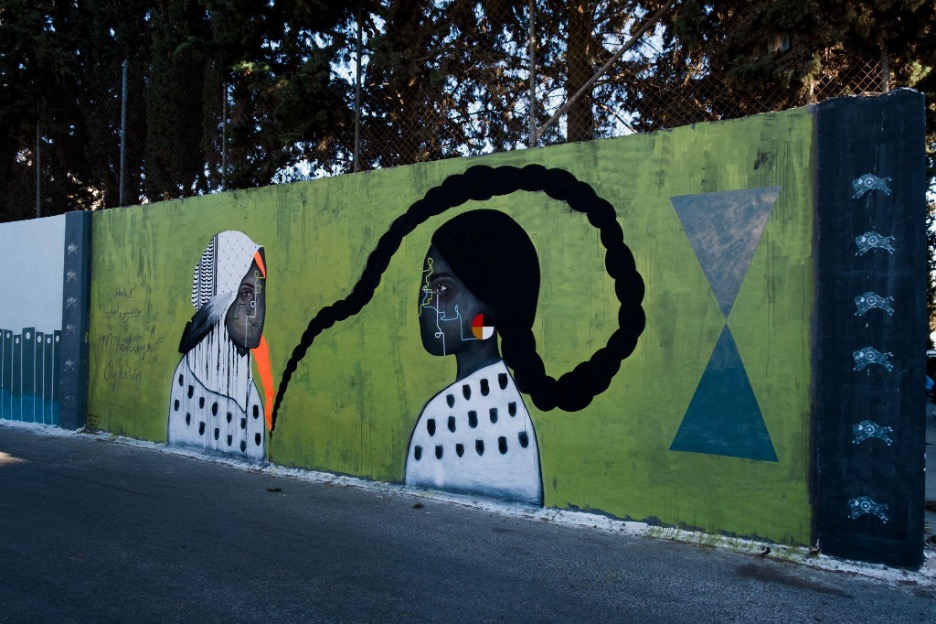
In this mural, SeeWalker repaints the portrait that appears in her painting “G is for Genocide,” the work behind the cancellation of her residency in Vail, Colorado. Facing it, she adds a second portrait of a Native American woman. The opposing triangles on the right side are a Native American motif known as “as above is below,” which SeeWalker has tattooed on her arm. The colored lines across each portrait reflect the loss each community carries after being expelled from its homeland. Native Americans searching for a new refuge sometimes lost their way, retraced their route, and settled somewhere else. Palestinians, after the Nakba in 1948, likewise went astray looking for refuge before settling in camps in the West Bank, the Gaza Strip, the suburbs of Jerusalem, Jordan, Lebanon, and Syria.
The parallel extends to the numbers: roughly 575 Native American tribes are federally recognized in the United States, while historians and scholars count around 530 Palestinian villages destroyed in 1948.
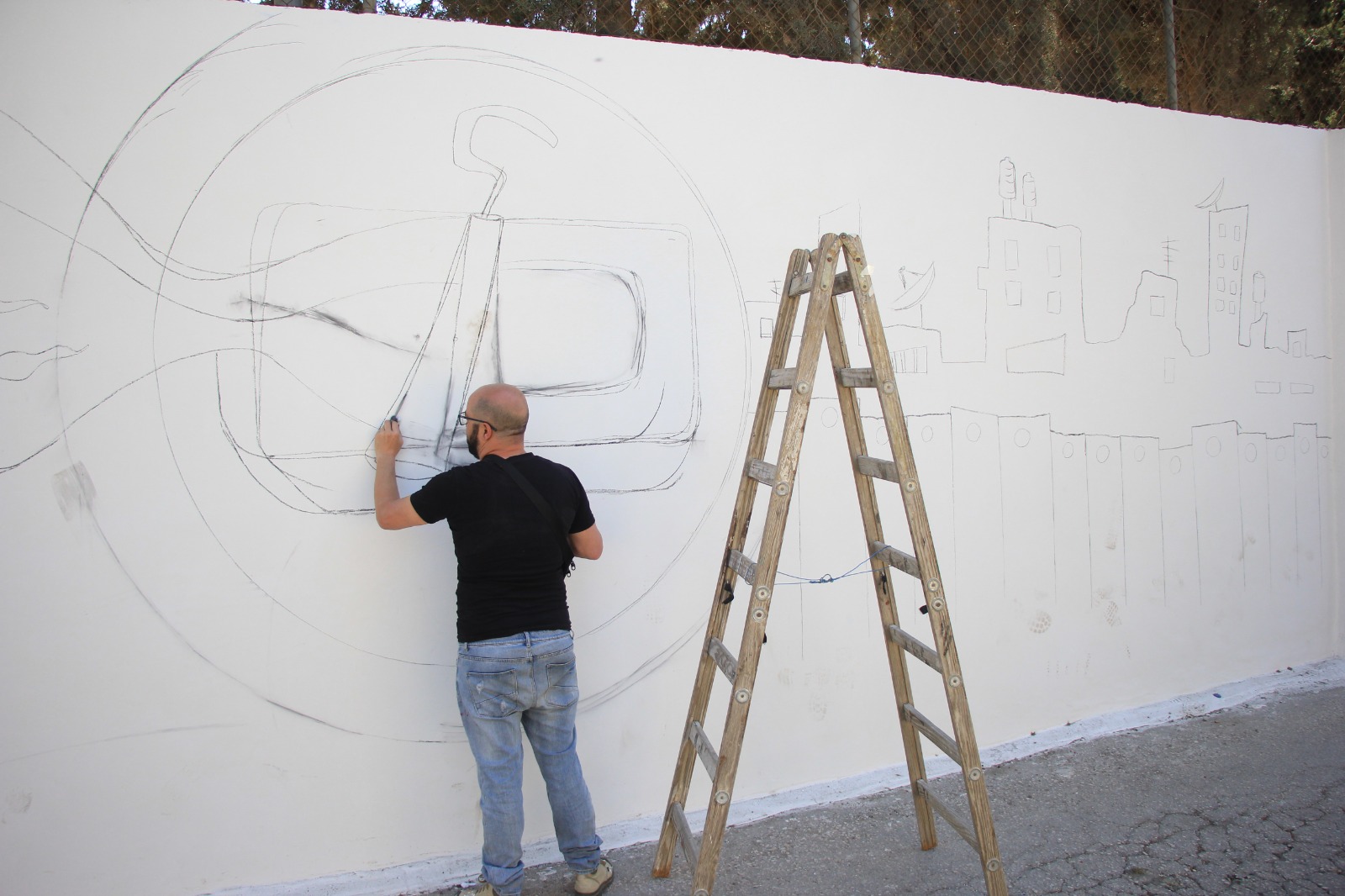
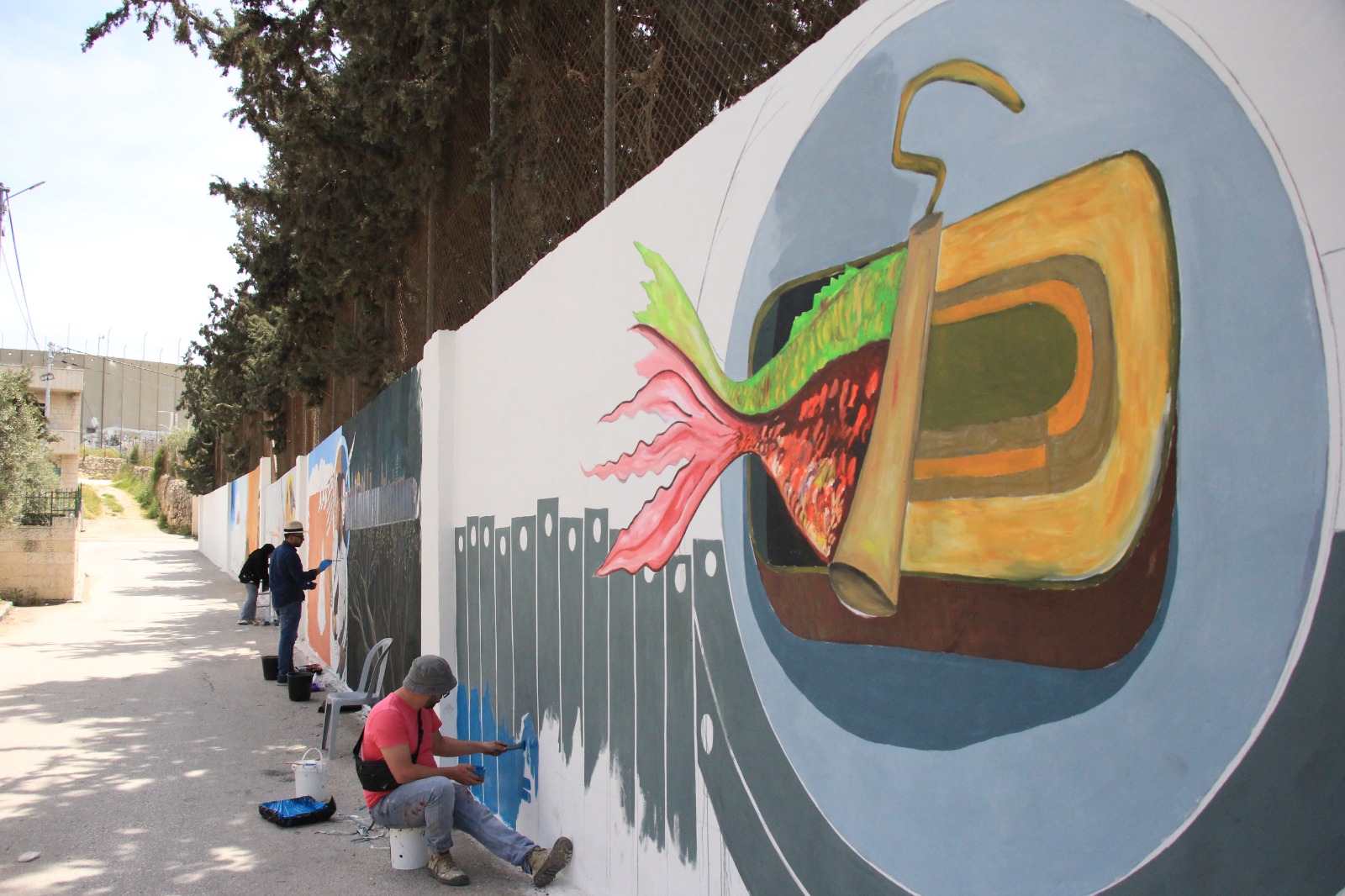
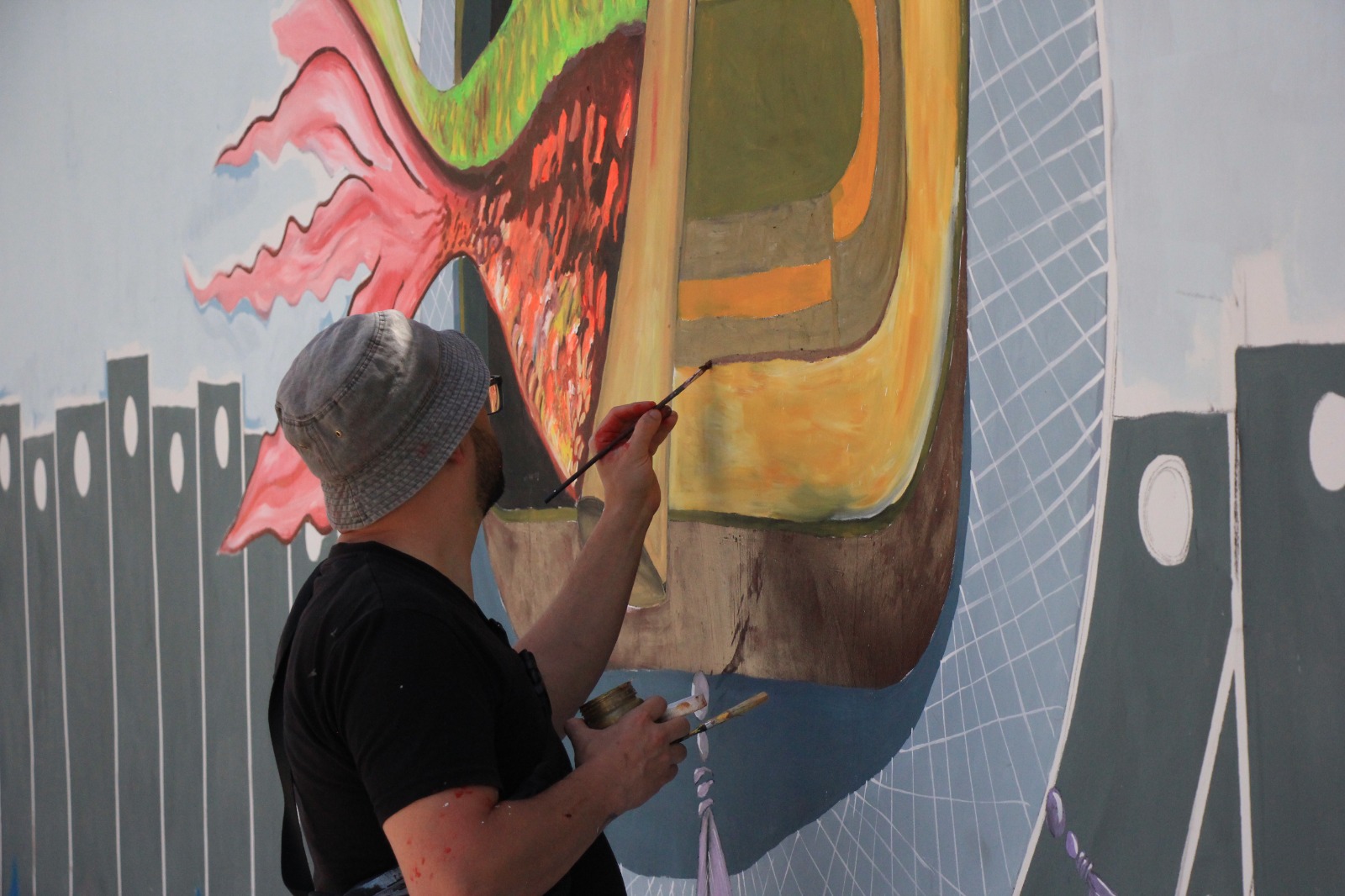
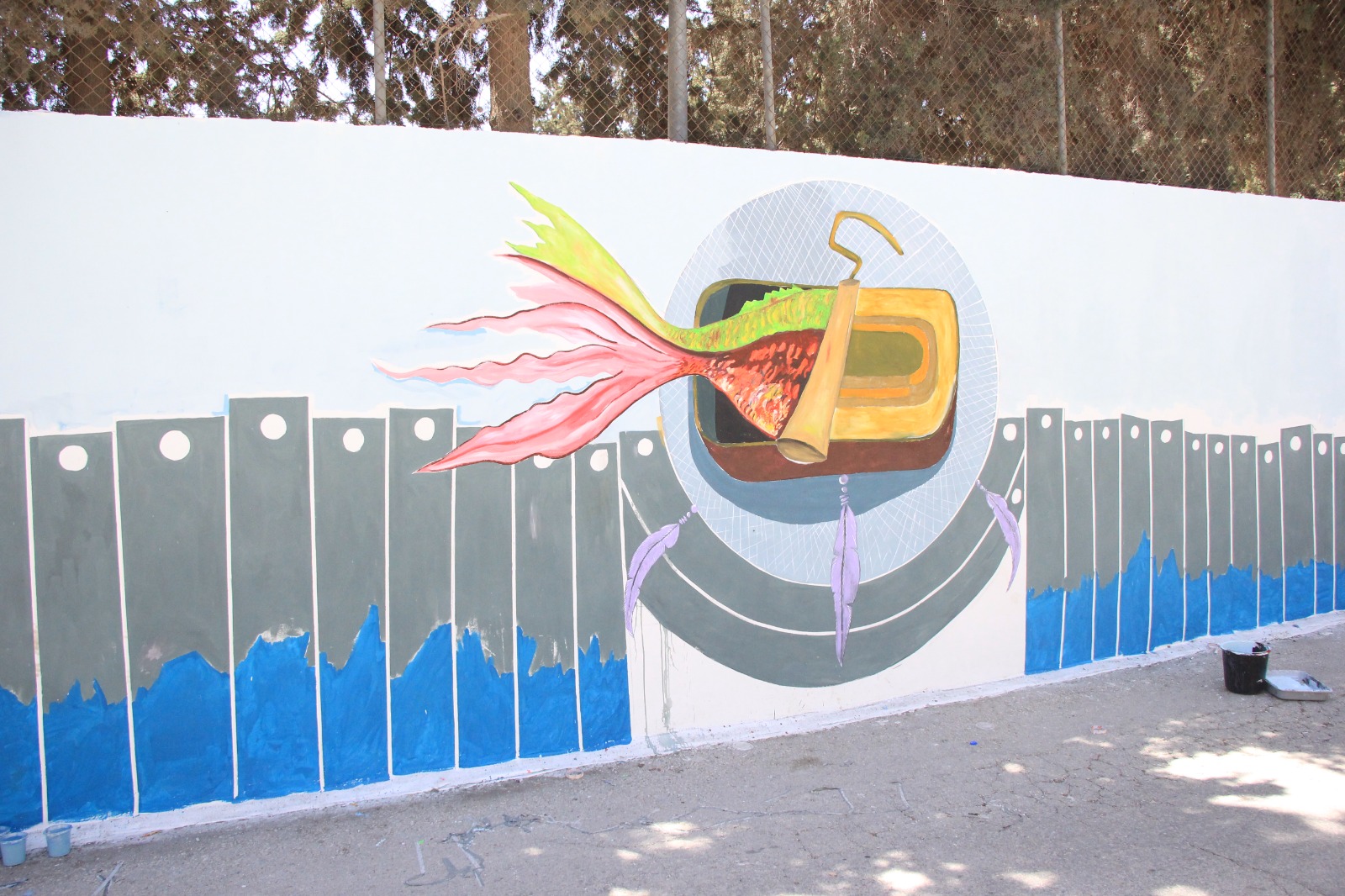
“Between Constraint and Dream,” by the artist Alaa Albaba, Aida Camp, 2026.
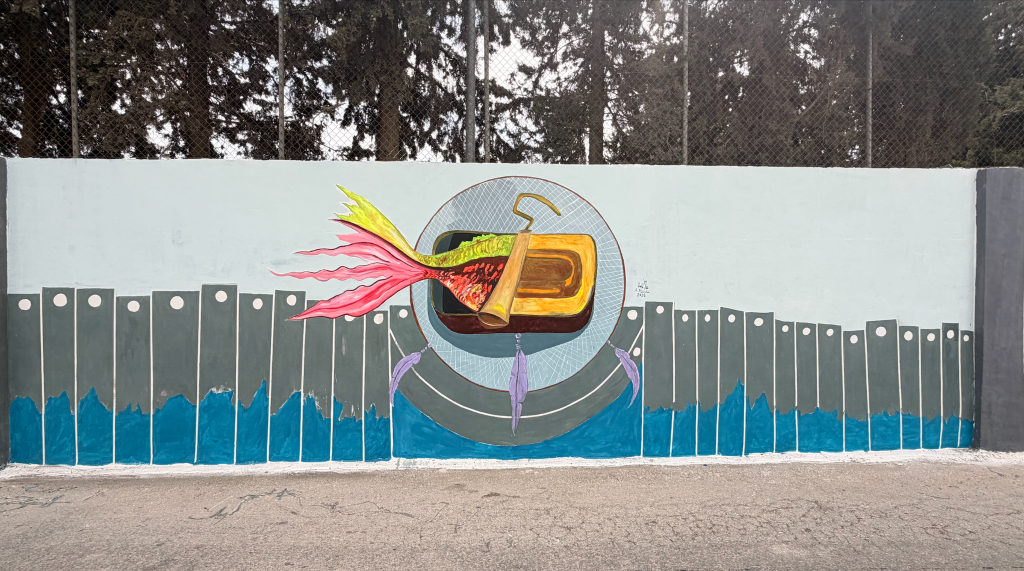
Photo courtesy of Lajee Center
Alaa Albaba, a painter, muralist, and member of the Palestinian Artists Consortium from Al-Amari refugee camp, placed his fish motifs front and center. The fish symbolize the two peoples. They emerge from a tin resting atop a Native American dreamcatcher, backdropped by the apartheid wall.
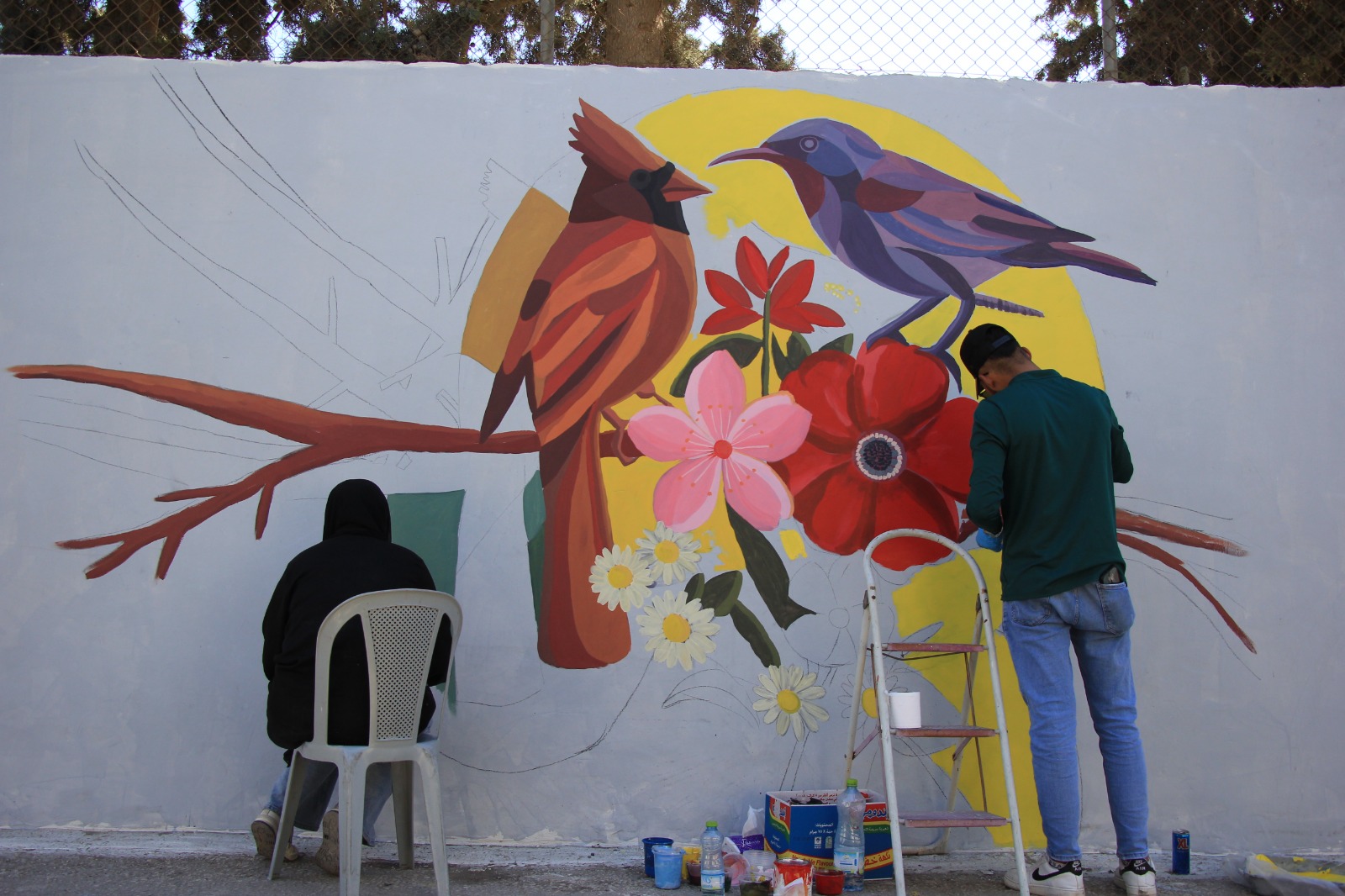
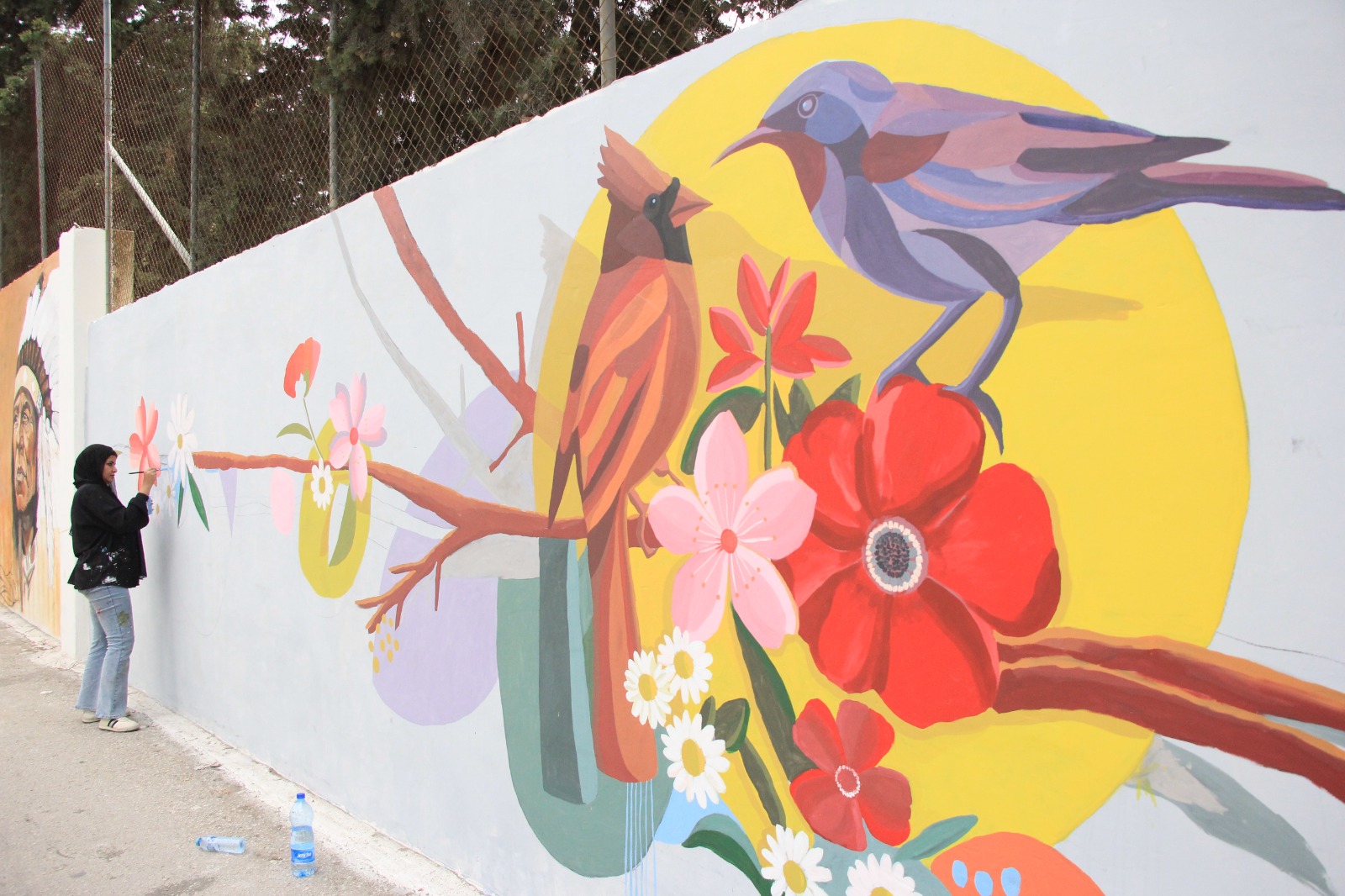
“The Sun will Rise Again,” by the artist Haya Kaabneh, Aida Camp, 2026.
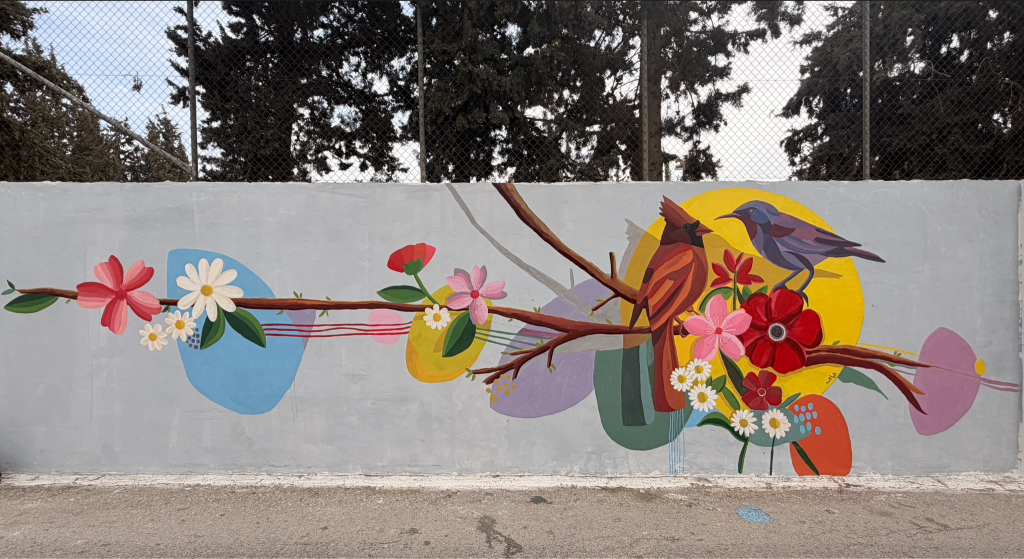
Photo courtesy of Lajee Center
Haya Kaabneh, a Palestinian visual artist and consortium member who lives in Jericho, depicts the Palestinian sunbird beside the cardinal, a bird dear to Native American peoples.
Centered on a tree branch that spans the length of the mural and surrounded by flowers, Kaabneh’s work highlights the wild beauty of both landscapes.
The mural gives space to something rarely addressed in discussions of existential conflict: the environmental dimension bound to the land. The birds, trees, and wildflowers form an essential part of the existence of Native American and Palestinian peoples. A bird, too, possesses the right to life, and a right to be described as a Palestinian, as a wildflower is.
“I find that expression through other living beings that share the earth with us is both necessary and imperative,” said Kaabneh.
The Palestinian sunbird, the northern cardinal, the Anemone coronaria, and the cardinal flower, Lobelia cardinalis, all embody survival and steadfastness, “sumud,” despite all circumstances that would stand in opposition. Also appearing in the mural is the yellow sun, a symbol associated with freedom for Palestinians, embodying the light that comes after darkness, and affirming that the right to life and hope are never lost.
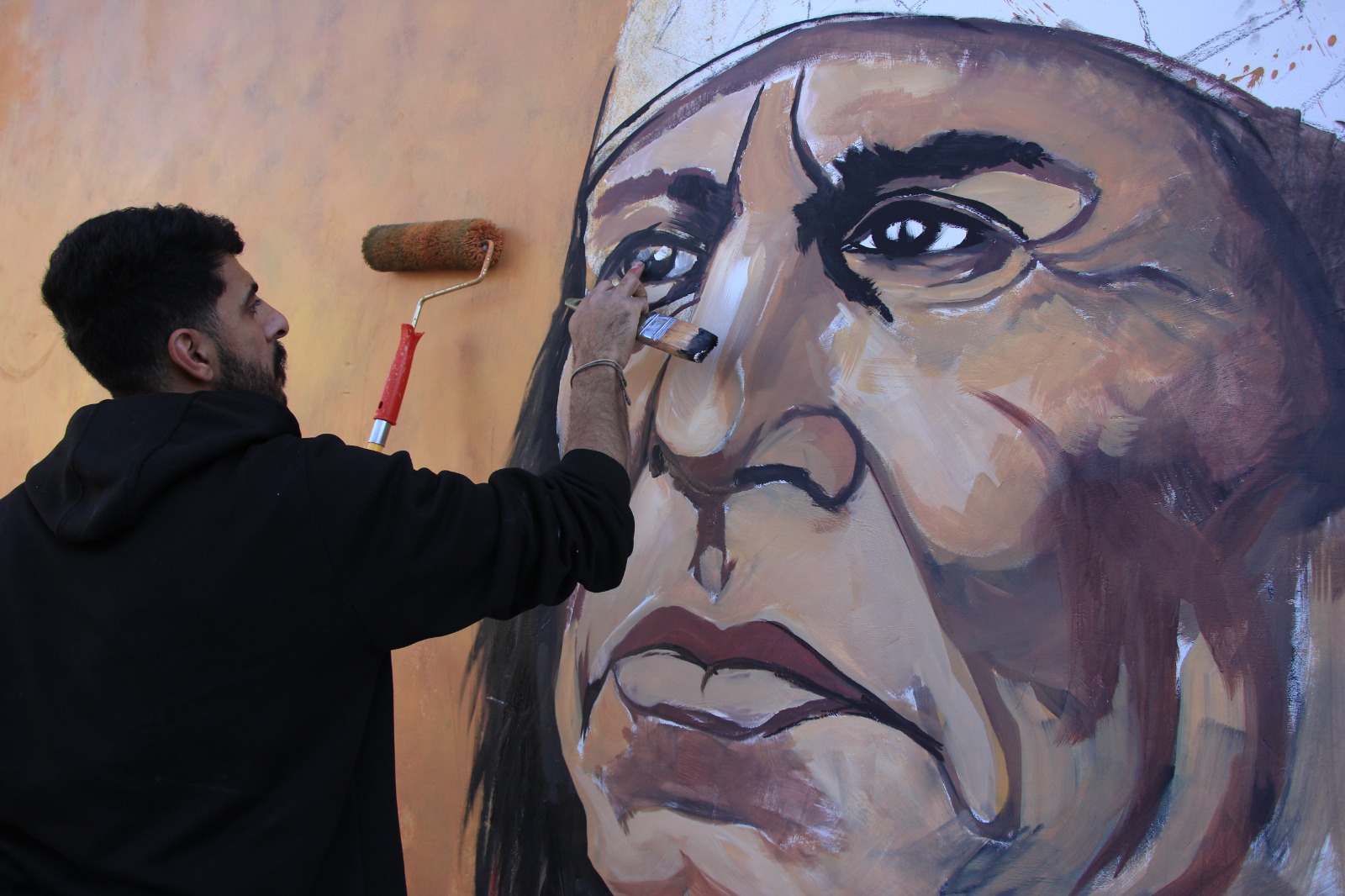
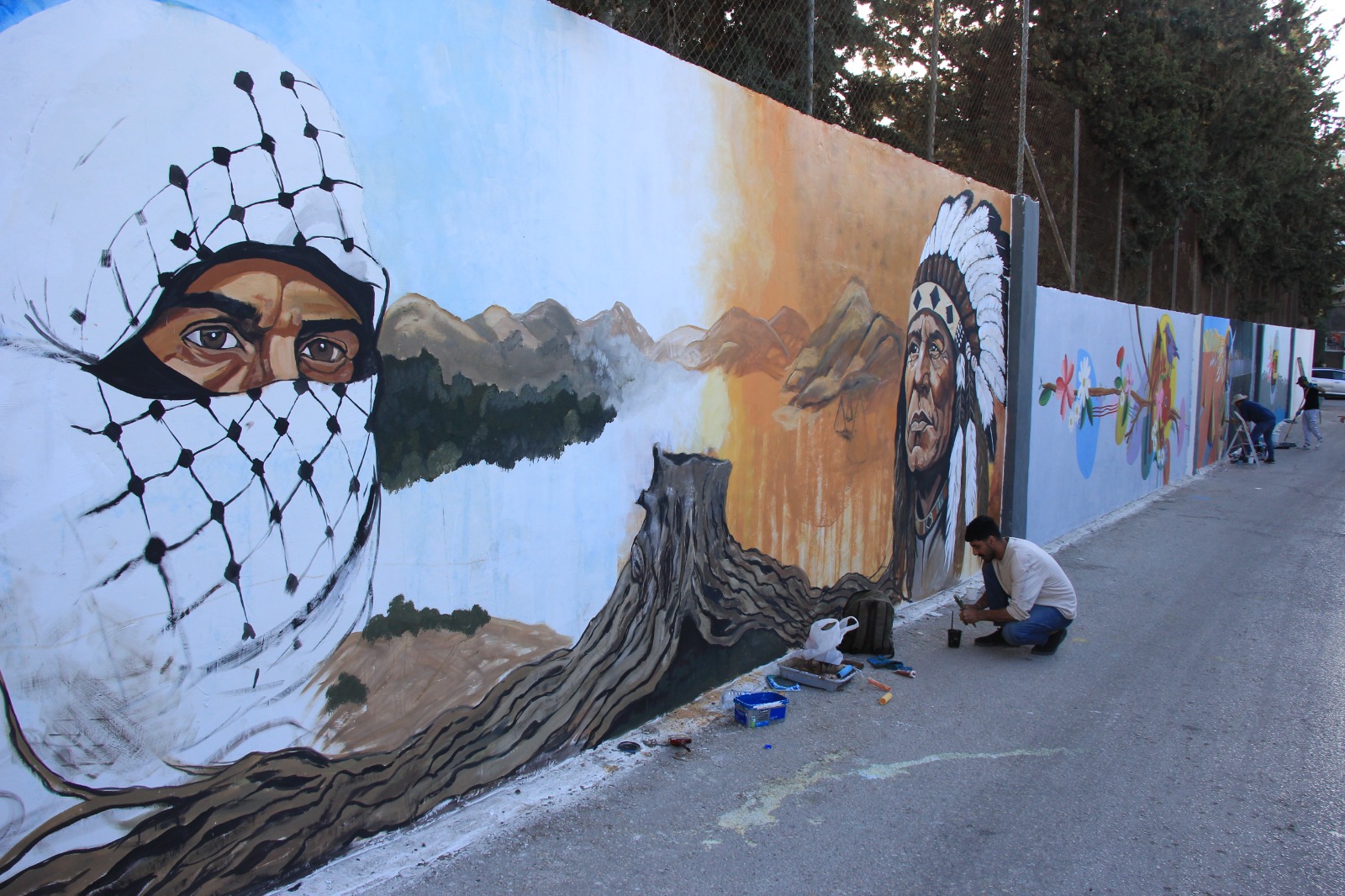
“Guardians of the Land,” by the artist Mohammad Al-Raee, Aida Camp, 2026.
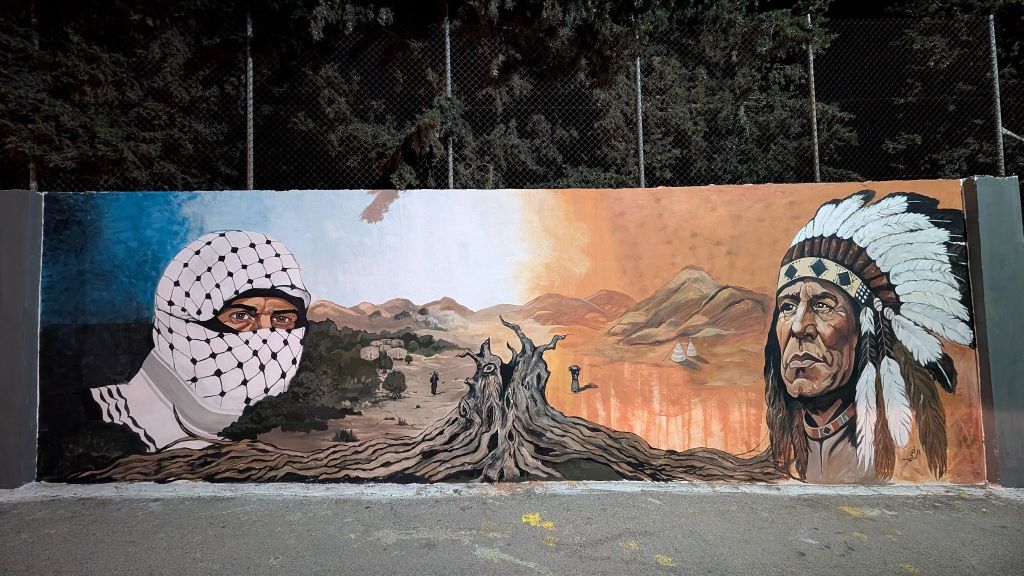
Photo courtesy of Lajee Center
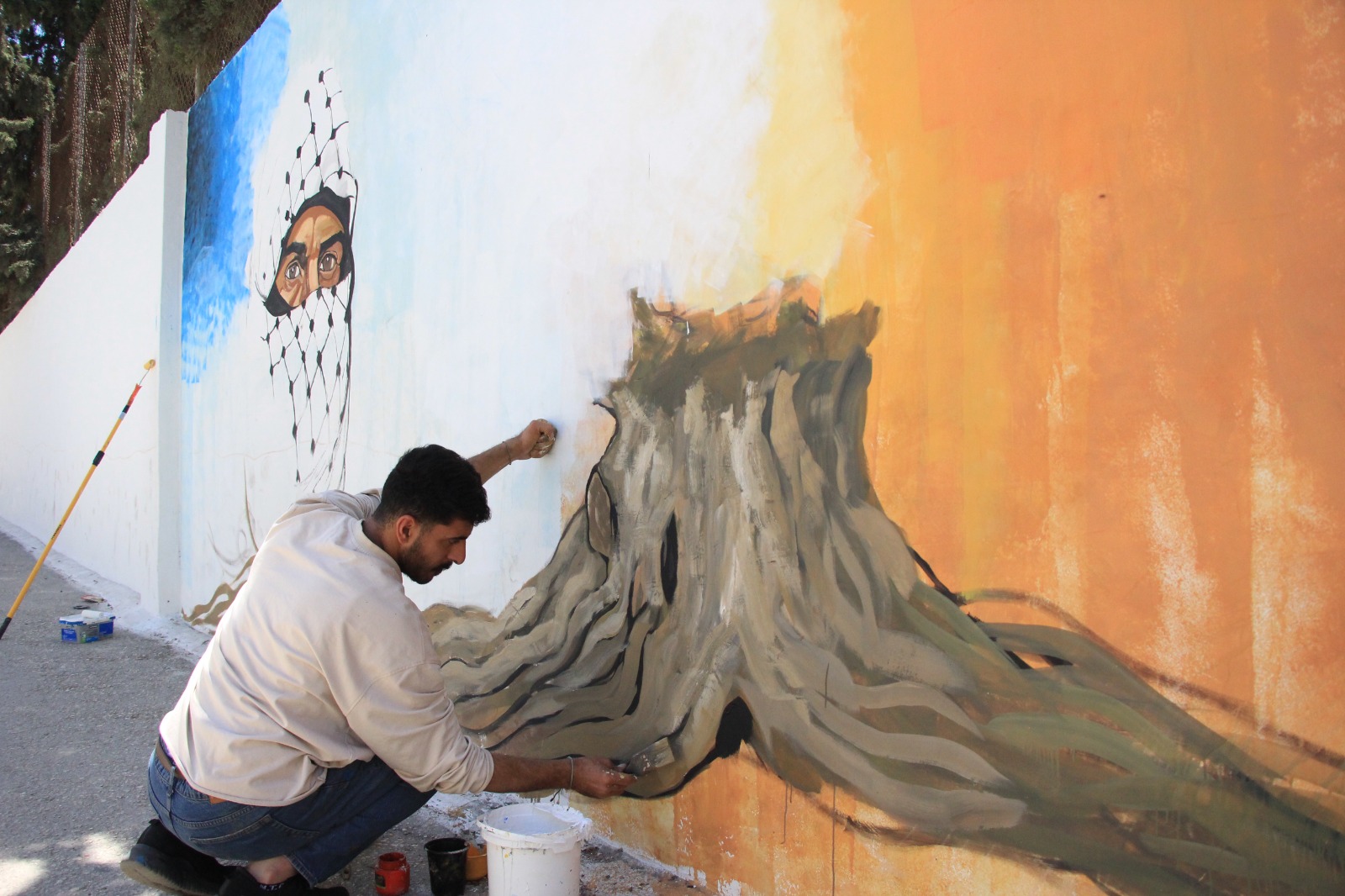
Mohammad Al-Raee, a visual artist and muralist from Al-Aroub refugee camp, sets two leaders side by side. On the right, the chief of a Native American tribe looks defiantly toward the horizon. On the left, Al-Mulatham, (a Palestinian masked activist), the masked figure of the Palestinian fighter, gazes directly at the viewer. Backed by their homelands and rooted together by the stump of an ancient olive tree, the two leaders hold their heads high as their resistance continues into new generations.
“From Palestine to Standing Rock,” a mural by the artist Ahmed Hmeedat, Aida Camp, 2026.
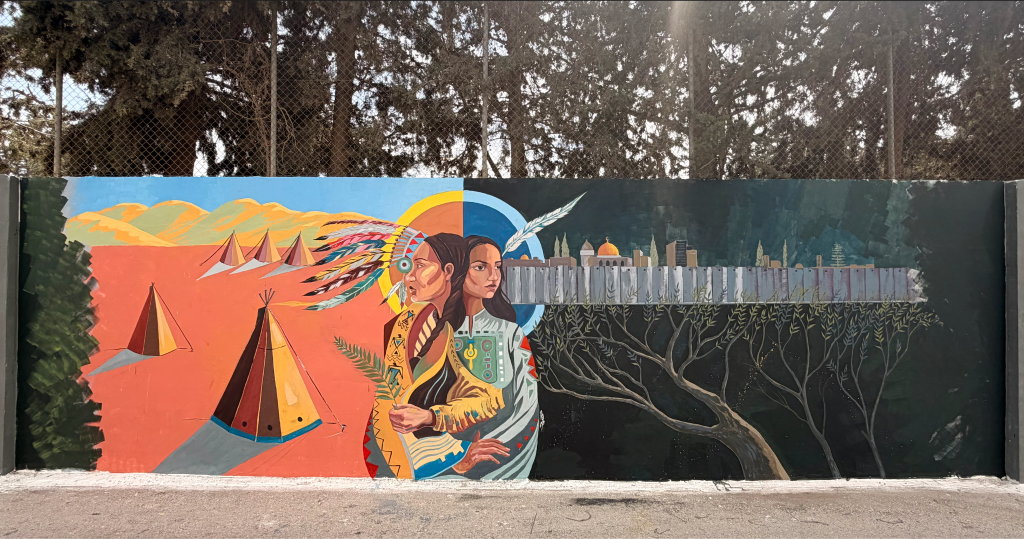
Photo courtesy of Lajee Center
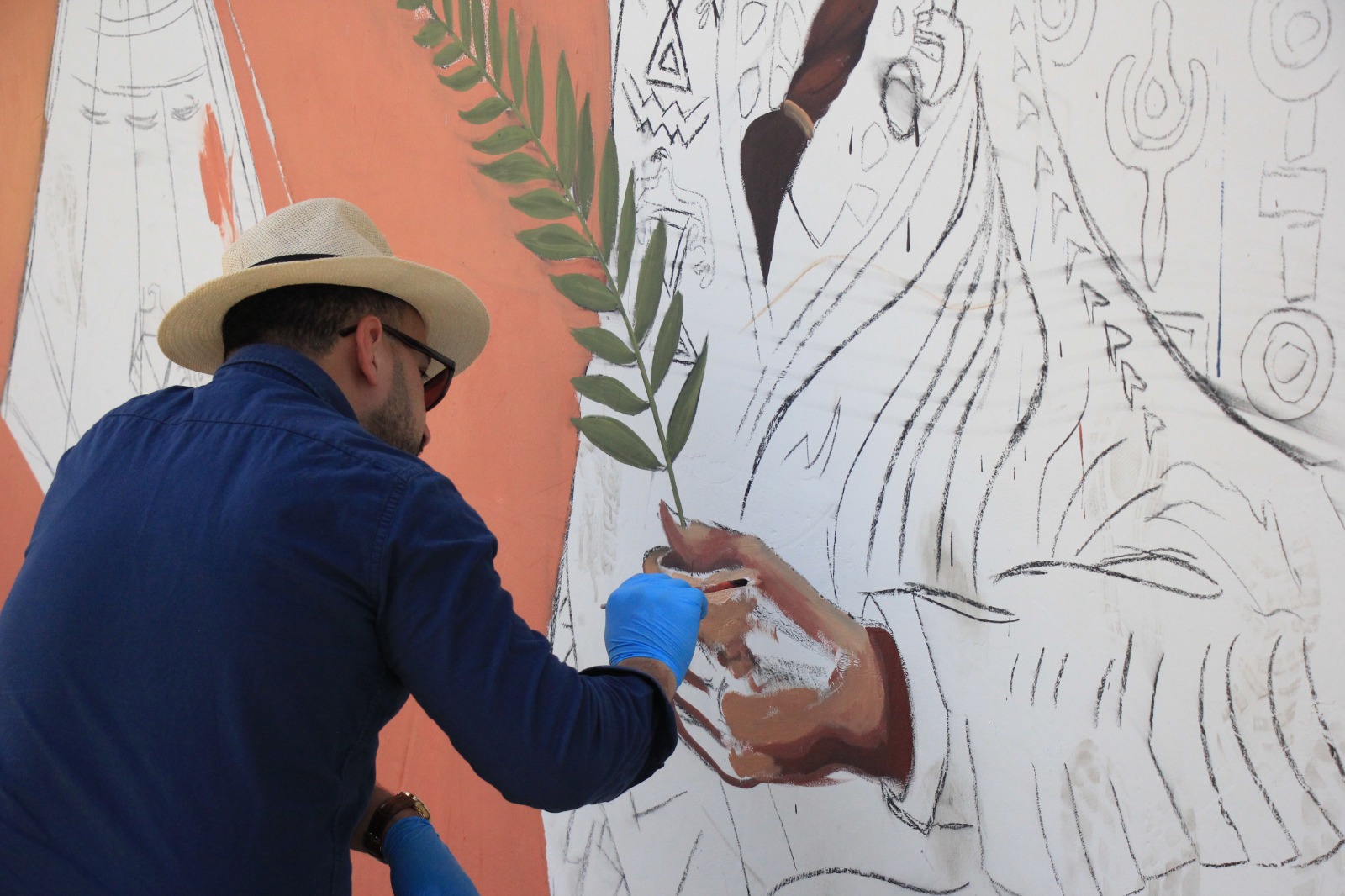
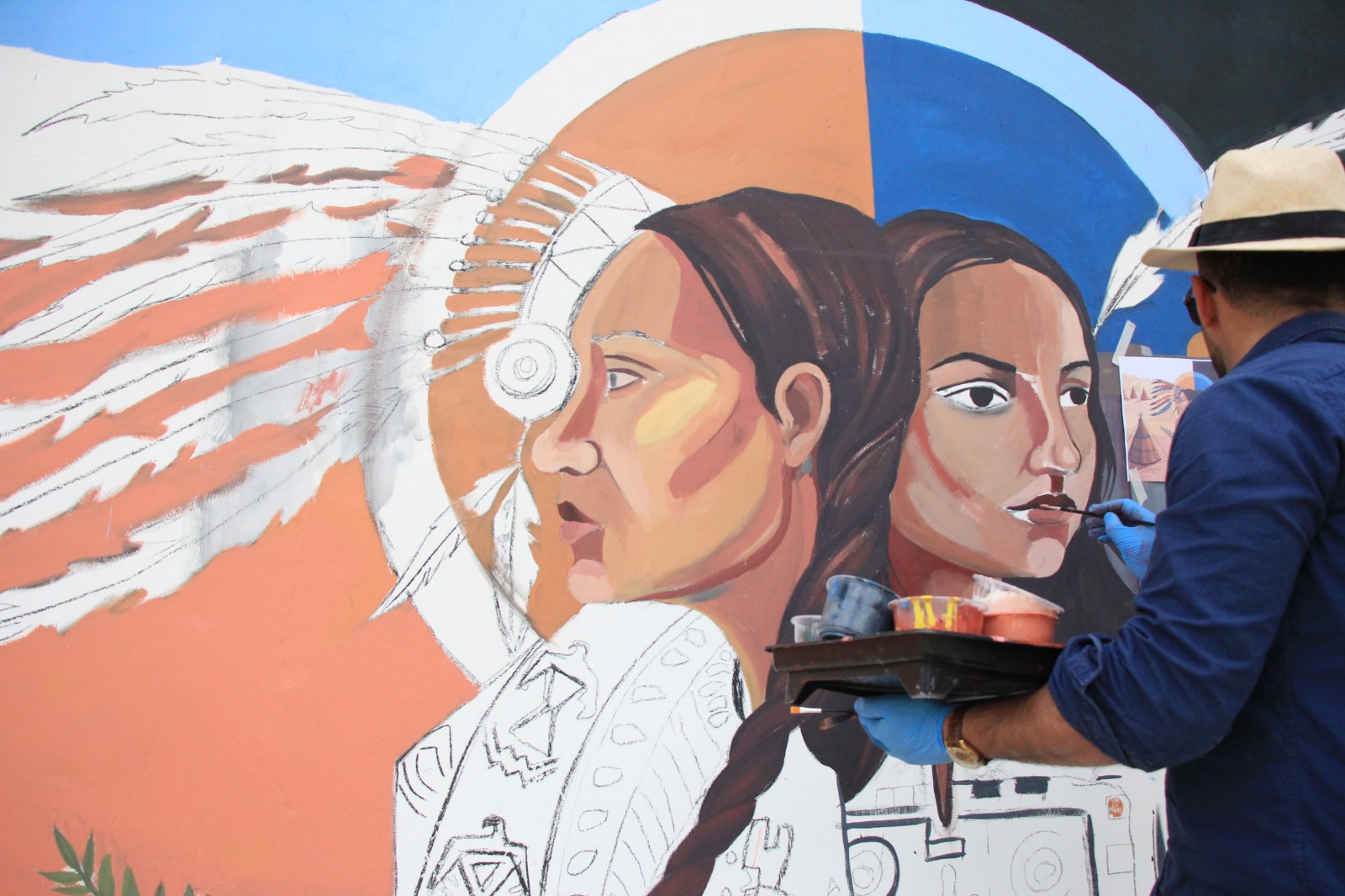
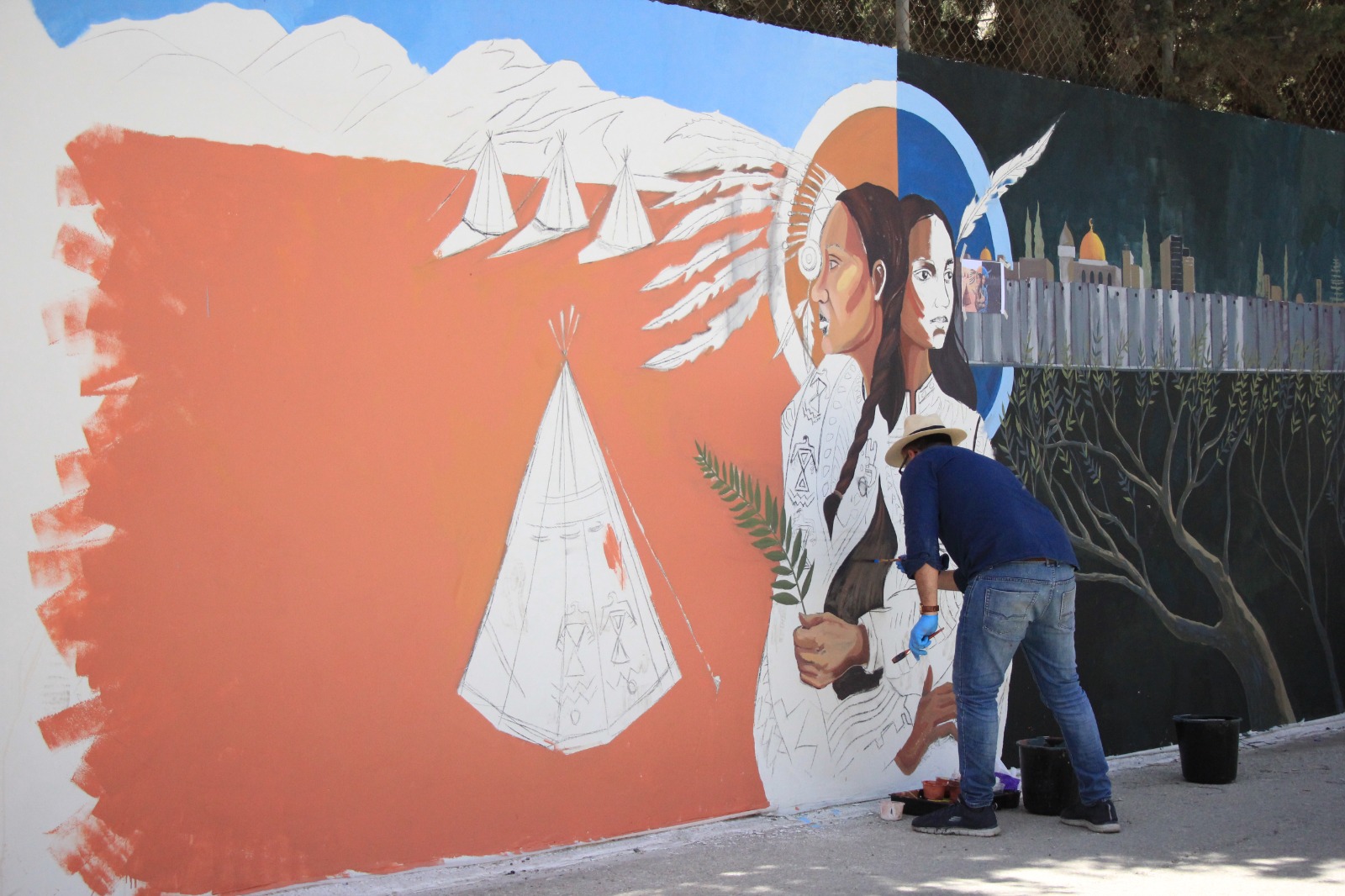
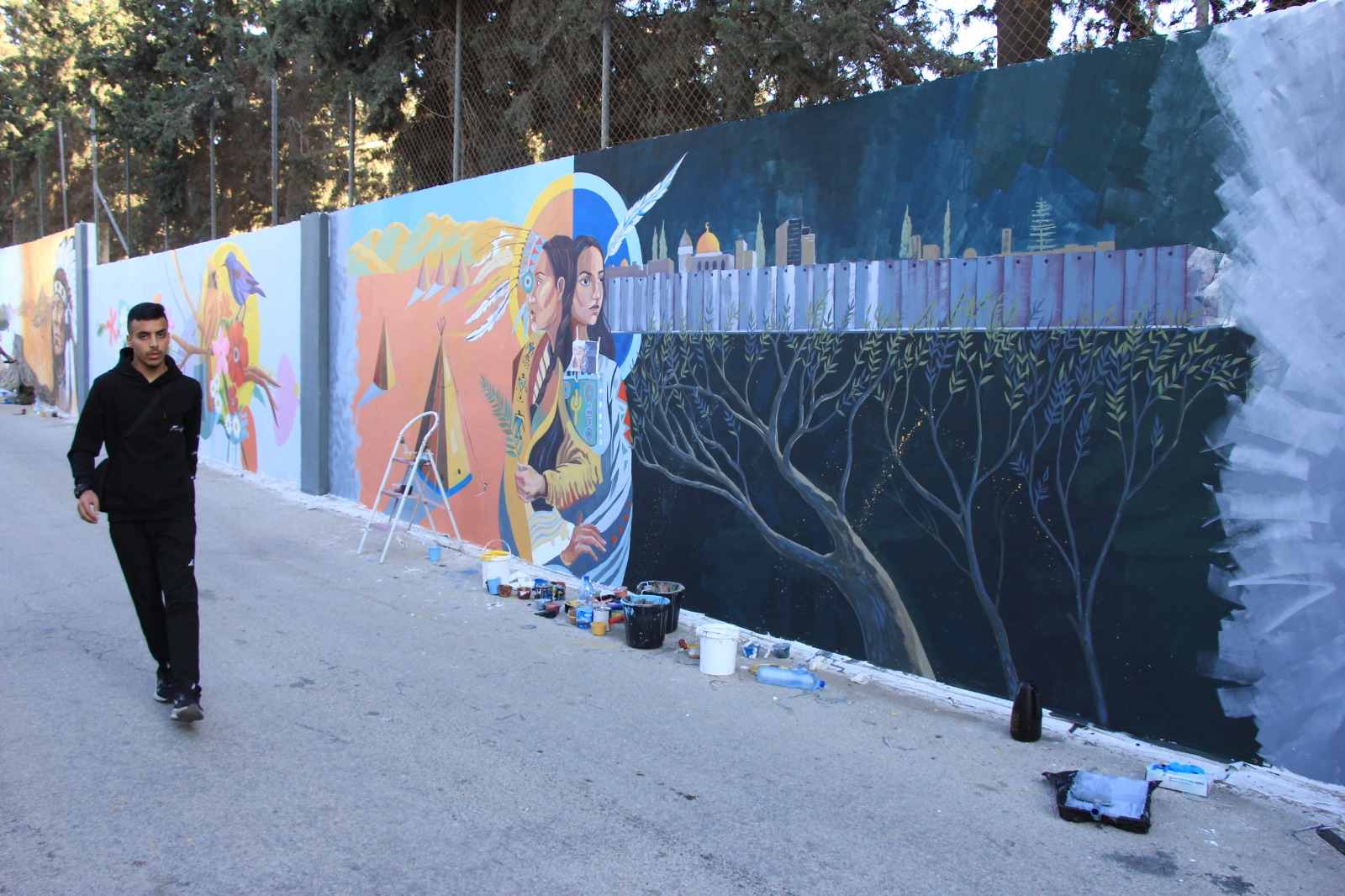
Ahmed Hmeedat, a visual artist, teaching artist, and founder of the Palestinian Artists Consortium, is from Bethlehem. His mural shows two women looking out toward their homelands.
“If we look closely at the feather crown placed on the head of the Native American woman, we notice that some of the feathers are missing,” said Hmeedat. The missing feathers stand for colonial efforts to strip Native peoples of their heritage and culture. The feathers that remain outnumber those that are gone, a deliberate signal that, despite those efforts, the steadfastness and resistance of Native peoples will prevail.
The murals were funded by a contribution from the Palestinian-American and Native American communities in the United States and carried out under the supervision of the Lajee Center in collaboration with the Palestinian Artists Consortium.
“Land Back,” a mural by the children of Aida Refugee camp, supervised by Artists: Mohammad Alraee and Danielle SeeWalker, Aida Camp, 2026.
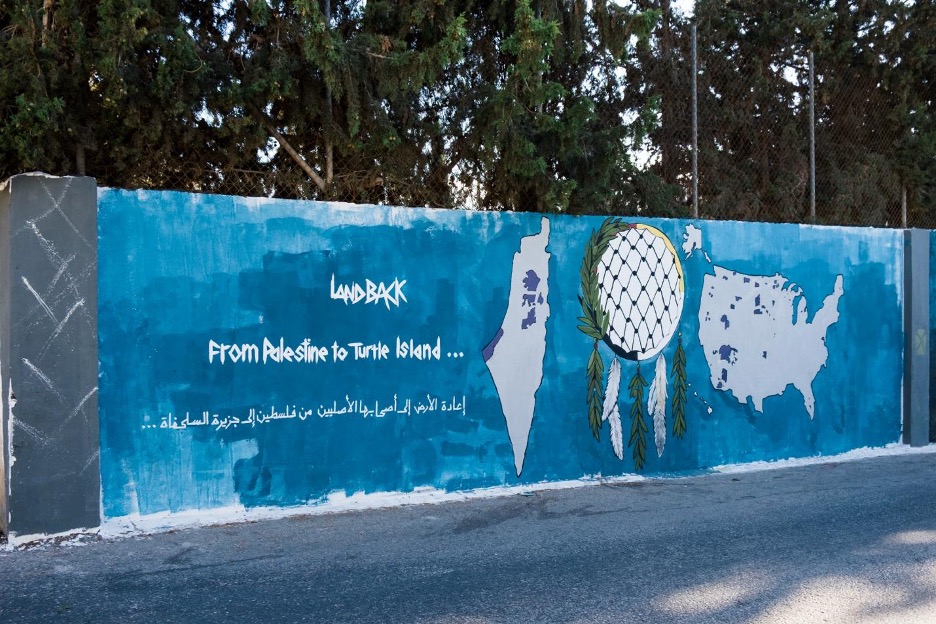
Photo courtesy of Image courtesy of Carlotta Cardana.
The idea for this mural was generated by children from Aida Camp and then developed and polished with the guidance of artists Mohammad Alraee and Danielle SeeWalker.
The children who attend Al-Raee’s beginner art classes were introduced to the themes of the murals and invited to contribute ideas for the “Kids’ Mural.” Their ideas were combined into a series of sketches that eventually evolved into the mural painted on the wall. The mural depicts maps of the United States, illustrating the dramatic reduction of Native homelands over time and the reservation lands where many Tribal Nations remain today. The map of historical Palestine resembles an archipelago of islands due to the contentious colonization and stealing of the land. Between the two maps, the children painted a combination of a dreamcatcher and the motif of a fishing net, inspired by the traditional Palestinian keffiyeh. The composition is surrounded by Native American feathers and Palestinian olive-branch leaves, bringing together symbols from both cultures.
Recently, all of these murals have been reproduced as high-quality woodcut prints and signed by the artists. Each print measures 70 × 40 cm (27.6 × 15.7 inches). The prints will be made available for purchase for those interested in owning a piece of this collaborative project. Each artist has signed a limited-edition series of 50 prints: 25 in black and white and 25 in color.
A link to order the prints will be available soon.
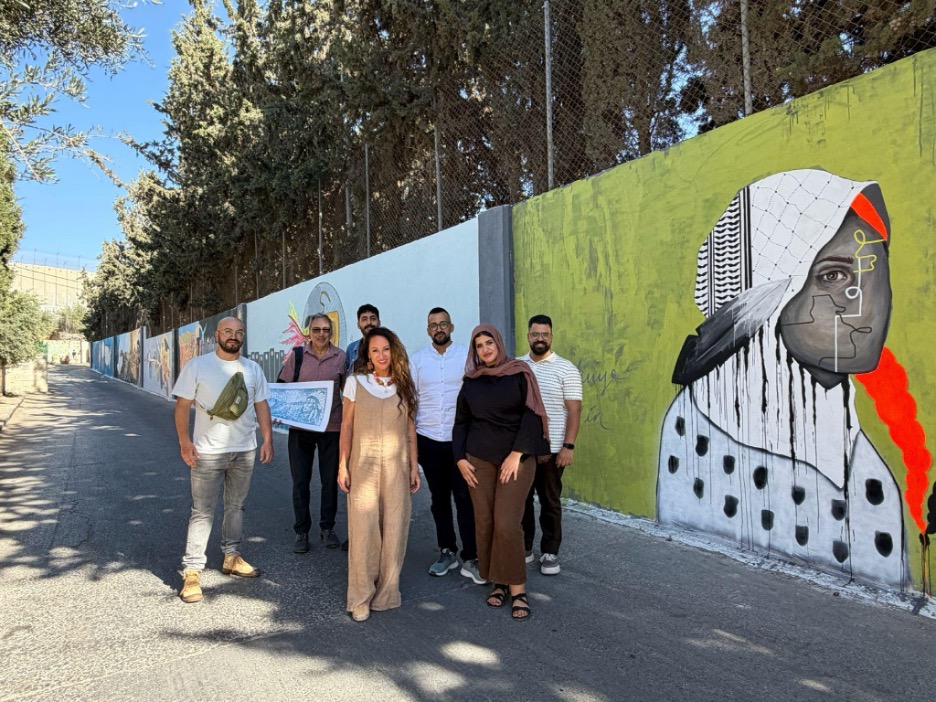
The Artists and Contributors
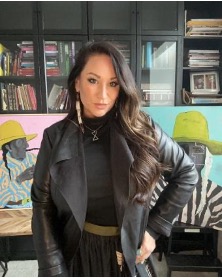
Danielle SeeWalker
Danielle SeeWalker is a Húŋkpapȟa Lakȟóta artist and citizen of the Standing Rock Sioux Tribe in North Dakota. An award-winning fine artist, muralist, writer, and advocate, she is based in Denver, Colorado. Through her multidisciplinary practice, SeeWalker partners with museums, galleries, cultural institutions, and communities across the United States and internationally to create work that sparks dialogue, challenges historical narratives, and celebrates the resilience and vitality of Indigenous peoples.
Working across painting, mixed media, public art, and installation, SeeWalker often incorporates traditional Native materials, symbolism, and storytelling with contemporary artistic approaches. Her work is rooted in her identity as a Lakȟóta wíŋyaŋ (woman) and reflects her commitment to uplifting Native American voices while advocating for Indigenous peoples around the world. By weaving together history, identity, and lived experience, she invites audiences to engage with the complexities of the past while envisioning a more honest and equitable future.
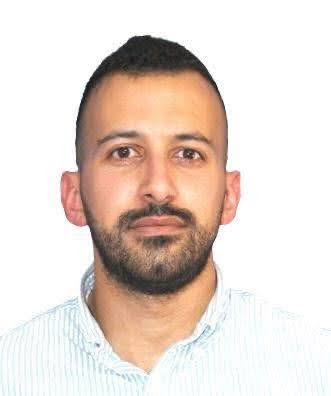
Ahmed Hmeedat
Ahmed Hmeedat is an artist from Bethlehem, Palestine. He has founded the Palestinian Artists’ Consortium Website in 2022, the only online platform that promotes the work of Palestinian artists and empowers them to navigate the global art market. Ahmed holds a BA degree in International Law from Al-Quds Bard College in East Jerusalem and another LL.M. degree in American Legal System from Syracuse University College of Law in Upstate New York.
He also contributed to establishing the first Palestinian museum in Washington D.C., the Museum of the Palestinian People, in 2019. The opening co-exhibit, “Re-imagining A Future in Palestine” has featured some of Ahmed’s artwork. Ahmed experiments with a variety of media, including watercolors, acrylics, oils, and charcoals as well as different printing techniques such as cyanotype, woodcut print, and silkscreen.
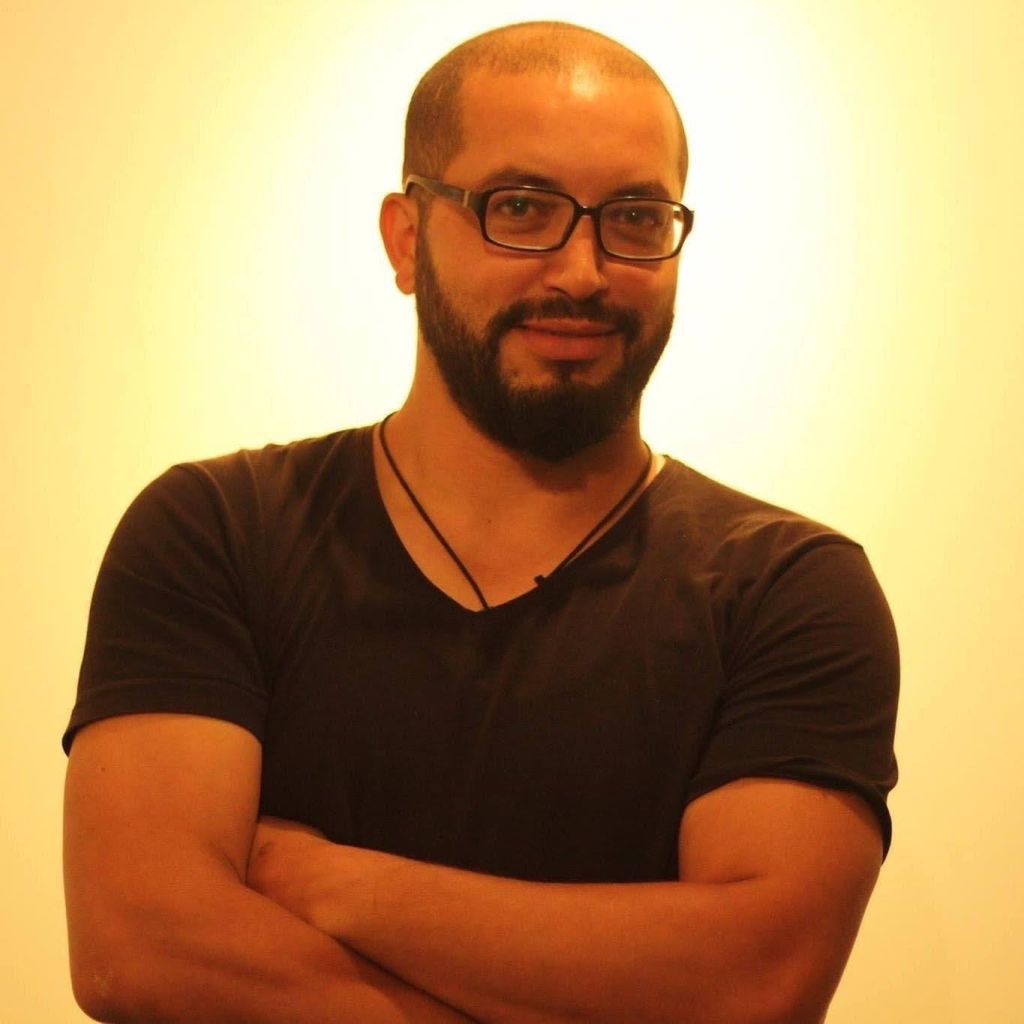
Alaa Al Baba
Born in 1984 in Jerusalem, is a distinguished Visual Community Artist and a Teaching Artist. In 2015, he pursued a Bachelor of Arts at the International Academy of Art Palestine, a pursuit he undertook from 2010 to 2015 through a scholarship awarded by Kio University in Norway.
Additionally, he honed his skills at the Visual Arts Forum in Ramallah from 2008 to 2010. In 2011 Albaba founded the ON THE WALL Studio “Almarsam” in the Al Amari Refugee Camp. Throughout his career, Albaba has been actively involved in various artistic residencies both within and outside Palestine. Notably, he participated in a Beirut residency focused on the Borj Al Shamali Refugee Camp and the Alhola massacre. There, he produced impactful sketches and murals rooted in the real-life stories of the camp.
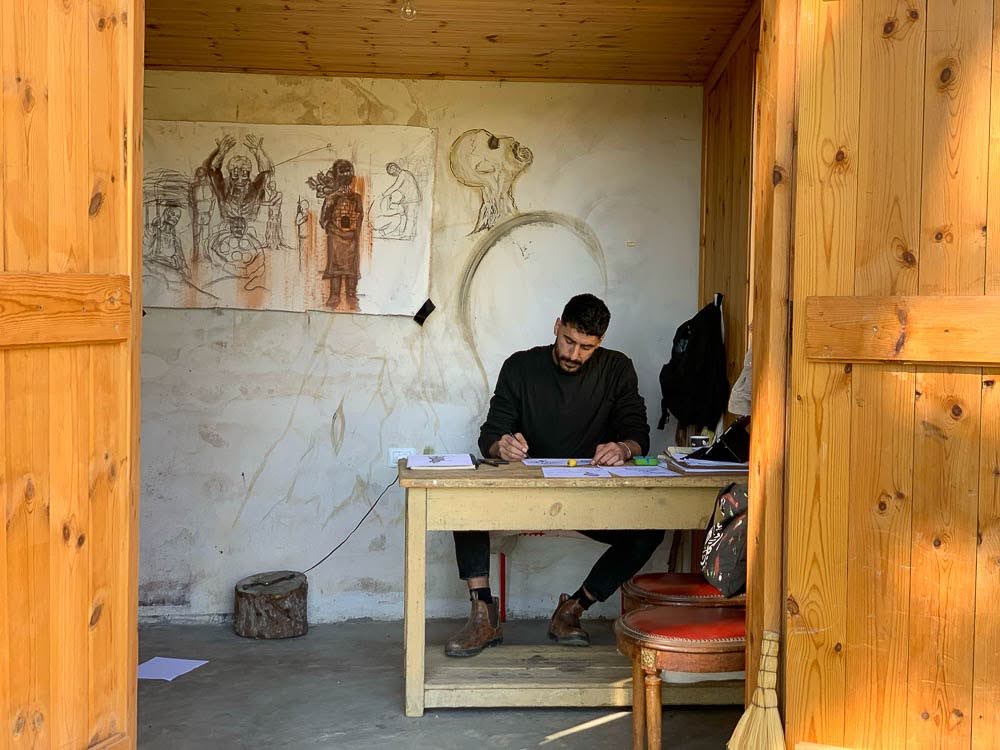
Mohammad Al-Raee
Mohamed Alraee is a multidisciplinary Palestinian artist whose work includes mural art and painting. He grew up in Al-Aroub Refugee Camp, where his artistic identity was shaped and where he developed a strong awareness of the relationship between art, space, and community. He transformed the walls of the camp into his first exhibition space, which later led him to create murals across various Palestinian villages, cities, and refugee camps. He has also participated in group exhibitions and multiple local artist residencies in Palestine.
Mohamed graduated from Park College with a diploma in sonography. Through his practice, he has developed an artistic approach that reflects Palestinian reality by reimagining and depicting nature, people, and daily life as visual expressions of resistance and resilience. His work engages with public art, collective memory, urban space, and the ongoing relationship between art and land.
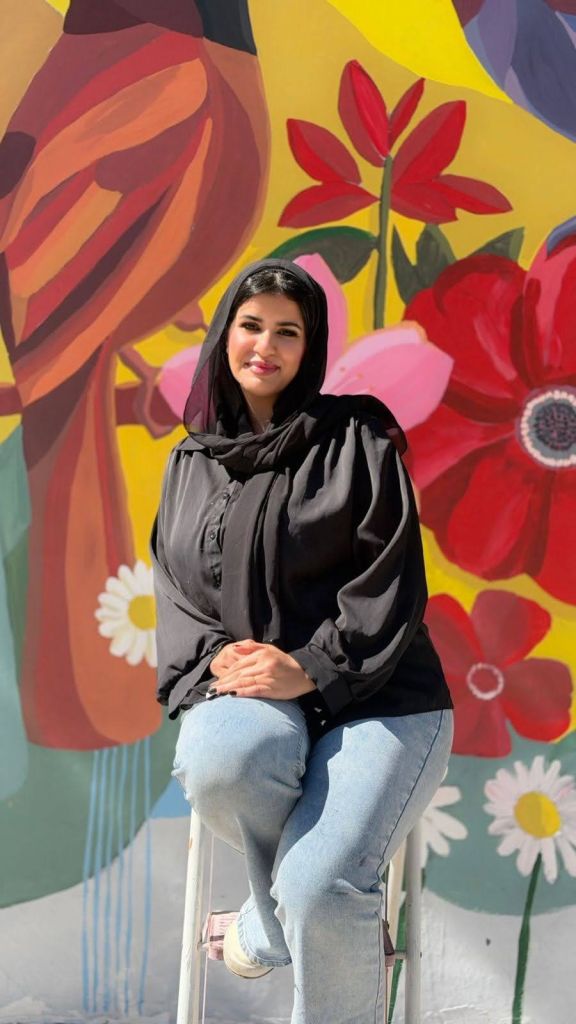
Haya Kaabneh
Haya Kaabneh is a Palestinian visual artist, born in 1991 in Jordan. She has participated in a number of exhibitions in Palestine and abroad, displaying works in Gallery One, the A.M. Qattan Foundation, the Museum of the Palestinian People (USA), among others. In 2019, Haya launched her first solo exhibition, in collaboration with The Walled Off Hotel, Bethlehem. Primarily using watercolour and acrylic, the artist has produced a large body of work focusing on the plight of Palestinian women as they struggle to change their status quo.
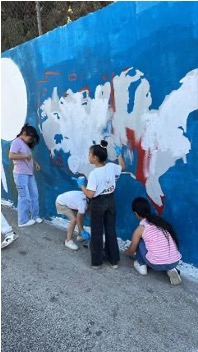
Children of Aida Camp
- Nadia Obaidallah
- Hanan Al-Azza
- Touleen Sadouq
- Beirut Owais
- Ilyaa Owais
- Sharaf Al-Azza
- Ibrahim Issa
- Yafa Al-Sheikh